2026 Sales Quotas Are Rising Because the Job Has Changed
 Julia
Julia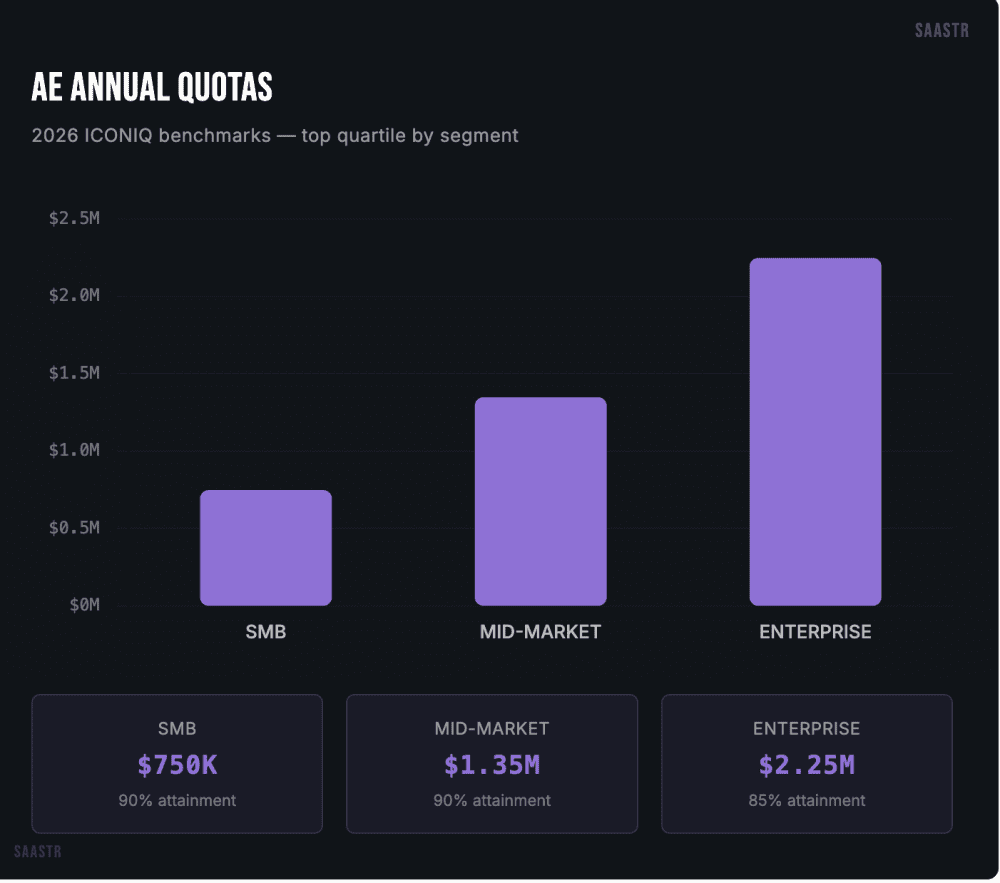
Across the B2B revenue organizations we study, the most damaging sales-planning mistake is remarkably consistent: leadership lifts the number, changes nothing else, then acts surprised when attainment falls and good reps start taking calls from recruiters.
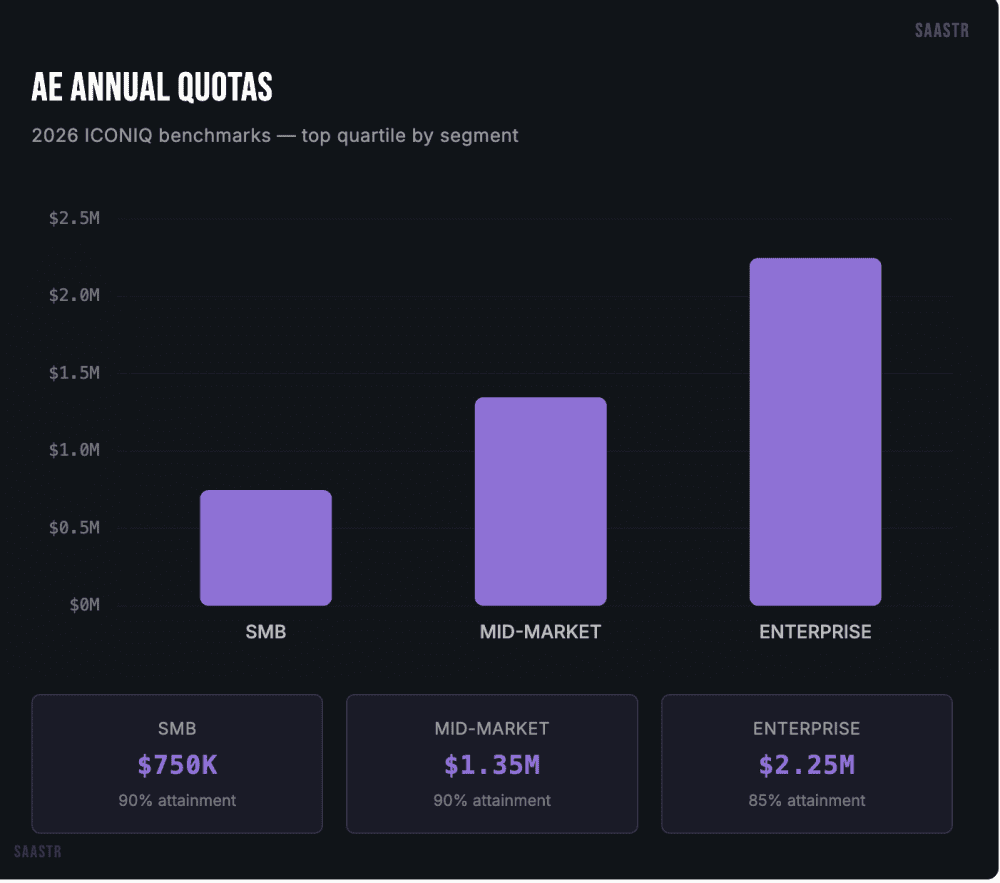
That is why the 2026 quota conversation deserves more discipline than the usual debate over whether targets are “too high.” The headline figures are substantial: $750K annual quota for SMB, $1.35M for mid-market, and $2.25M for enterprise. But treating those numbers as evidence that every sales leader should simply demand more from every AE would be lazy management.
The better reading is more consequential. The highest-performing teams are supporting higher annual quotas with a redesigned revenue model: more compensation tied to expansion, more responsibility for cross-sell and upsell inside Sales, and more AI embedded in the systems that create and qualify pipeline.
Get practical tips to manage marketing without adding noise.
Short field notes on positioning, distribution and turning expertise into demand. Written for founders and operators, not marketers chasing trends.
Quota has risen because the job has changed. That distinction determines whether a company builds a compounding revenue system or burns through its sales team chasing an arbitrary spreadsheet target.
Higher quotas are an operating-model outcome, not a motivation tactic
We take a firm position here: a higher quota is defensible only when the company has created more addressable revenue for the rep, better infrastructure for finding it, and clear incentives to pursue it. Anything else is quota inflation.
The 2026 benchmark numbers matter because high-performing companies are not pairing higher targets with collapsed attainment. Their baseline expectations are approximately 90% attainment at a $750K annual quota for SMB and a $1.35M quota for mid-market. At the enterprise level, strategic AEs carry a $2.25M annual quota with roughly 85% attainment.
That is not a story about sales leadership discovering that reps had been underworked. It is a story about companies making the revenue role broader and more leveraged.
- SMB AEs at leading organizations carry approximately $750K in annual quota with around 90% attainment.
- Mid-market AEs carry approximately $1.35M with around 90% attainment.
- Strategic enterprise AEs carry approximately $2.25M with around 85% attainment.
- These figures represent the upper end of successful performance, not an automatic quota prescription for every B2B company.
That last point deserves emphasis. The $2.25M enterprise figure belongs to strategic AEs in top-quartile companies. It sits within a broader enterprise benchmark range of roughly $1.4M to $3M, just as mid-market inside-sales benchmarks commonly sit between $600K and $1.4M. A founder who sees the top-end number and imposes it on a team without the corresponding market, account strategy, sales motion, or pipeline engine is not adopting a benchmark. They are copying a result without building the conditions that produced it.
The real change is that Sales now owns more of the account
For too long, B2B companies treated the AE as a new-logo specialist and treated the existing customer base as someone else’s problem. Customer success owned the relationship. Account management handled expansion. Finance watched retention. Sales collected credit for the first contract and moved on.
That model made organizational charts neat. It also fragmented commercial ownership at exactly the moment when expansion revenue became one of the most valuable and controllable growth levers available to SaaS and cloud businesses.
High-performing teams are correcting that fragmentation. Sales owns cross-sell at 65% of high-performing companies, compared with 49% of other companies. Sales owns upsell at 55%, compared with 44%. Sales owns renewals at 37%, compared with 24%.
Those are not cosmetic responsibility changes. They change the economic surface area of the AE role. A rep who can identify a second team, an adjacent use case, a bigger deployment, or a renewal risk is working a larger revenue opportunity than a rep confined to a single initial transaction.
This is also why the compensation shift matters more than the quota headline. Average AE compensation tied to Net New Recurring Revenue rose from 25% to 33% year over year. Compensation tied to Net Dollar Retention rose from 18% to 23%.
Companies are putting more of the pay plan behind what the business actually needs: durable new recurring revenue and expansion within the installed base. That is the correct direction. It aligns the sales organization with the company’s long-term value creation instead of rewarding a narrow version of acquisition that can leave retention and account growth stranded between functions.
There is a hard truth inside this shift. Expansion ownership cannot be announced in a kickoff deck and considered complete. If Sales owns upsell but has no account intelligence, no clean customer data, no product-usage visibility, no rules of engagement with customer success, and no credible compensation credit, then the company has not created expansion ownership. It has created friction.
AI is raising the productivity ceiling, but only when it is embedded in the system
The second reason high performers can carry more quota is AI-enabled pipeline creation. This part is already attracting plenty of empty hype, so precision matters.
AI is not a substitute for product-market fit. It does not turn an incoherent message into a compelling one. It does not make an enterprise buyer sign a contract they do not need. And it certainly does not rescue a weak sales process merely by adding automated outbound volume.
What it can do is increase the productive capacity of a coherent GTM system. Companies with AI embedded in GTM processes generated about twice as much net new revenue per full-time employee as medium and low adopters. That is the number sales leaders should focus on-not the novelty of the tool, but the operating leverage it creates.
When prospect research, account prioritization, workflow routing, follow-up, data hygiene, and signal detection improve together, the rep spends less time manufacturing activity and more time working qualified commercial opportunities. That gives a company a rational basis for expecting more revenue per seller.
The strongest signal is not that SDRs and Marketing are using AI. That has become expected. The more important movement is inside Revenue Operations: daily AI experimentation in RevOps increased from 34% to 54% of the function in a single year.
That is where the durable advantage sits. RevOps is where data becomes territory design, routing logic, account scoring, pipeline visibility, compensation administration, forecasting discipline, and handoffs between teams. If AI only makes outbound faster, it creates more activity. If AI improves the revenue operating system, it creates leverage.
And leverage is the only honest justification for a higher quota. The company should be able to point to the mechanism: stronger expansion ownership, clearer incentives, better account coverage, cleaner pipeline creation, and systems that remove manual work. “We need a bigger number this year” is not a mechanism.
The quota mistake to avoid: importing a top-quartile number into an average system
Every benchmark creates a predictable temptation. A CEO sees a top-performing company with higher quotas and asks why their own team cannot carry the same number. The question is understandable. The conclusion is often wrong.
A top-quartile quota is the output of a system. It reflects the company’s account economics, product maturity, sales motion, installed-base opportunity, pipeline efficiency, and management discipline. It is not a number that can be detached from those inputs and applied through force of will.
This is especially important for businesses that have not yet decided what kind of growth motion they are building. A company that wins a small number of high-value accounts needs a different sales architecture from one that relies on broad-volume acquisition. Growth data makes the distinction clear: startups that began as deer hunters and remained there grew revenue at an average of 22% year over year, compared with 2% for mouse hunting, 4% for rabbit hunting, and 5% for elephant hunting.
The point is not that every company should pursue a deer-hunting strategy. The point is that revenue design must match the motion. Quota cannot be separated from customer selection, account strategy, and how the company creates demand. A target built for a focused, high-value account motion will break a team operating a broad, low-value motion.
When leaders skip that design work, the downstream damage is predictable. Reps lose confidence in the plan. Managers spend more time explaining targets than improving execution. Forecasts become theater. Attrition risk rises because high performers can tell the difference between an ambitious business and one that has confused pressure with strategy.
What sales leaders should recalibrate now
The useful action from these 2026 GTM benchmarks is not “raise quotas.” It is “audit whether the revenue system can support the quota you intend to set.”
- Start with revenue ownership. Define exactly who owns the initial sale, cross-sell, upsell, and renewal. Ambiguity destroys both accountability and compensation credibility.
- Pay for the behavior the business needs. If expansion and retention determine company value, compensation cannot remain overwhelmingly attached to a first contract alone.
- Measure AI by revenue leverage. The relevant standard is not tool adoption. It is whether AI improves pipeline quality, workflow speed, data reliability, and net new revenue per employee.
- Set quota by role and motion. SMB, mid-market, enterprise, and strategic enterprise are not interchangeable jobs. Their targets should reflect the customer economics and support systems around each role.
- Use attainment as a diagnostic. A higher quota with sustained 85% to 90% attainment indicates an operating model that is working. A higher quota with collapsing attainment indicates a design failure that needs attention.
There is a broader principle here for founders and revenue leaders: discovery is a business function. Pipeline does not arrive because salespeople work harder. It is produced through a connected system of positioning, account selection, distribution, operational data, workflow design, and disciplined follow-through.
That is why distribution beats isolated content, and systems outperform manual effort. The same logic applies inside sales. A rep’s quota is not merely a personal challenge. It is a measure of what the company’s revenue system can reliably put within reach.
TL;DR: Raise quotas only after you raise the capacity of the system
The 2026 leaders carrying $750K SMB quotas, $1.35M mid-market quotas, and $2.25M strategic enterprise quotas are not simply demanding more effort from the same sales model. They are redesigning the role around expansion revenue, shifting compensation toward Net New Recurring Revenue and Net Dollar Retention, and using AI to create more productive GTM systems.
That is the standard worth copying. Higher quotas are not the strategy. Higher productive capacity is the strategy. The quota is only the visible consequence.
Find the channels buyers already trust before competitors own them.
We map your acquisition channels, visibility gaps and distribution constraints, then show where market presence can compound into qualified demand.