Creator Commerce Breaks When the Catalog Cannot Answer the Question
 Julia
Julia
Creator commerce has a conversion problem that most brands are still misdiagnosing. The creator video worked. The audience understood the product. Demand was created in vivid, human language: the true shade of blue, the way the fabric sits on a body, whether the smartwatch is useful for health tracking, whether a case fits a specific device, whether the product works for someone with a particular need.
Then the shopper leaves the post.
That is where too many creator campaigns stop functioning as a growth system. The product is no longer being described by a creator who has given it relevance and context. It is being interpreted by Google Search, AI Mode, AI Overviews, ChatGPT, Gemini, Perplexity, Amazon, Google Merchant Center, and increasingly by shopping interfaces built to answer a buyer’s complete question rather than match a loose keyword.
Get practical tips to manage marketing without adding noise.
Short field notes on positioning, distribution and turning expertise into demand. Written for founders and operators, not marketers chasing trends.
At Codolie, this matters because discovery is now a business function, not a media by-product. A brand can spend heavily to generate creator-led demand and still lose the sale when its product catalog cannot carry the meaning that created the demand in the first place. That is not an influencer problem. It is an infrastructure failure.
Creator marketing without catalog alignment is rented attention
Our position is straightforward: creator commerce should not be managed as a content channel. It should be managed as a demand-to-discovery system.
Creators increasingly supply the language shoppers actually use when they want to buy. They do not say “blue dress, size 10” and leave it there. They explain that the dress is a muted blue rather than bright cobalt, that it has room through the waist, that it works for a fuller bust, that it looks structured on camera but feels light in person. That context is what converts a product from inventory into an answer to a buyer’s problem.
But AI shopping assistants do not watch a creator video and magically retain every useful detail forever. They need product information they can retrieve, interpret, compare, and match to a conversational request. If the catalog only says “Blue Dress, Size 10,” it cannot reliably serve a shopper asking where to find the blue dress the creator wore that fits a size 10. The creator generated the demand. The catalog failed to preserve it.
That gap is becoming more expensive as shopping moves from browsing toward recommendation. A buyer can now ask for a product based on compatibility, fit, function, color nuance, use case, or comparison criteria. They are not merely scanning a page of results. They are asking a system to narrow the market on their behalf.
The brands that win will not be the ones with the most creator posts. They will be the ones whose products remain findable after the post has done its job.
Key Takeaways
- Creators create high-value product language, but that value disappears when fit, compatibility, color, and use-case details are missing from product data.
- AI shopping assistants reward machine-usable product knowledge, not vague marketing copy or incomplete merchant feeds.
- Creator briefs, product pages, structured data, and Google Merchant Center feeds need to describe the same product with the same factual precision.
- Measurement must move beyond AI visibility toward AI-mediated discovery: retrieval, citation, shortlist inclusion, correction rates, referral behavior, and downstream revenue.
Creators are producing the product vocabulary that search used to miss
The old search model trained brands to think in nouns. Product title. Category. Brand. Color. Size. Maybe a few keyword-heavy descriptions added after the fact.
Creator-led commerce has exposed how inadequate that model is. People do not buy only by noun. They buy through constraints, preferences, anxieties, comparisons, and lived context. They want the travel bag that fits under an airline seat, the foundation that does not pull orange in daylight, the running shoe that works for a certain gait, the charger that supports the device they own, or the dress that fits the way it appeared on a creator with a similar body type.
That language is commercially valuable because it reflects intent at a far higher resolution than generic product copy. It is the difference between “smartwatch” and “smartwatch for health tracking.” It is the difference between “blue dress” and “blue dress with a forgiving fit in a specific size.”
Creators are exceptionally good at generating this context because they make products legible in human terms. Their job is not to fill a merchant feed. Their job is to show why an item matters, what it does, who it helps, and what reality looks like after purchase. That is precisely why creator content can drive demand so effectively.
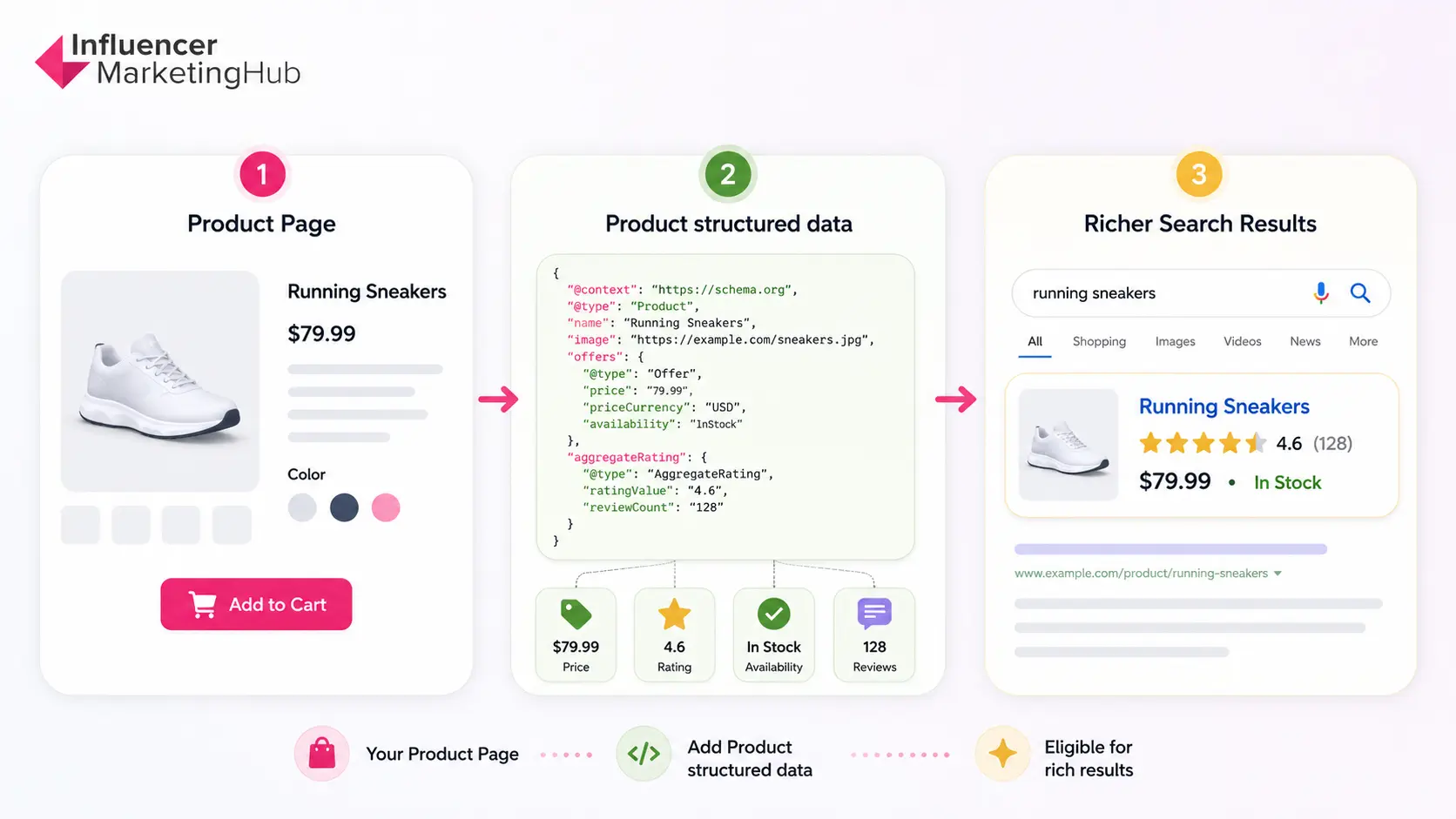
But AI shopping systems create a hard operational requirement: the language that makes the product desirable has to be connected to the structured information that makes the product retrievable.
The AI cannot safely infer attributes that a brand has not supplied. It cannot treat a creator’s passing description as dependable product truth when the product page, structured data, and merchant feed are silent or contradictory. It cannot confidently recommend a product for a compatibility need when compatibility is buried in an image, implied in a caption, or absent from the catalog entirely.
That is why product data accuracy is no longer back-office housekeeping. It is distribution infrastructure.
The product page is now the handoff between influence and discovery
Most brands still treat the creator post as the campaign asset and the product page as the destination URL. That is too passive for how discovery now works.
The product page, structured data, and merchant feed are the handoff layer between what the creator made a shopper care about and what a search or AI system can confidently recommend. If that handoff is weak, the campaign becomes dependent on the original post, the original platform, and the original creator link. That is a fragile form of growth.
A brand that depends on a shopper returning to the exact creator video has not built distribution. It has borrowed it.
If Google presents a product inside AI Mode or AI Overviews, the decisive issue is not whether the brand bought enough Google Ads. It is whether the product can answer the buyer’s stated need with clear, consistent, machine-readable information. As AI shopping becomes more conversational, product data becomes the effective ad unit.
This is the practical shift from product marketing copy to product knowledge. A catalog needs to carry the attributes that matter in purchase decisions:
- Accurate colors rather than broad color labels that erase meaningful differences.
- Fit and sizing details that explain how an item wears, not simply which sizes are available.
- Compatibility information that makes clear what a product works with and what it does not.
- Functional attributes that support comparison and recommendation.
- Current inventory and feed accuracy so a recommendation does not lead to an unavailable or mismatched item.
- Consistent entity and structured-data signals across the product page, feed, and indexed brand knowledge.
None of this is glamorous. That is exactly why it is a defensible advantage. Most companies would rather commission another campaign than repair a weak product-information model. Yet the second investment makes every future campaign more durable.
Do not turn creator briefs into scripts. Turn them into intelligence.
The wrong response is to force creators into lifeless product specifications. No one needs another creator reading a merchant feed aloud. The human, attribute-rich context is the point. It is what gives creator commerce its credibility and its commercial power.
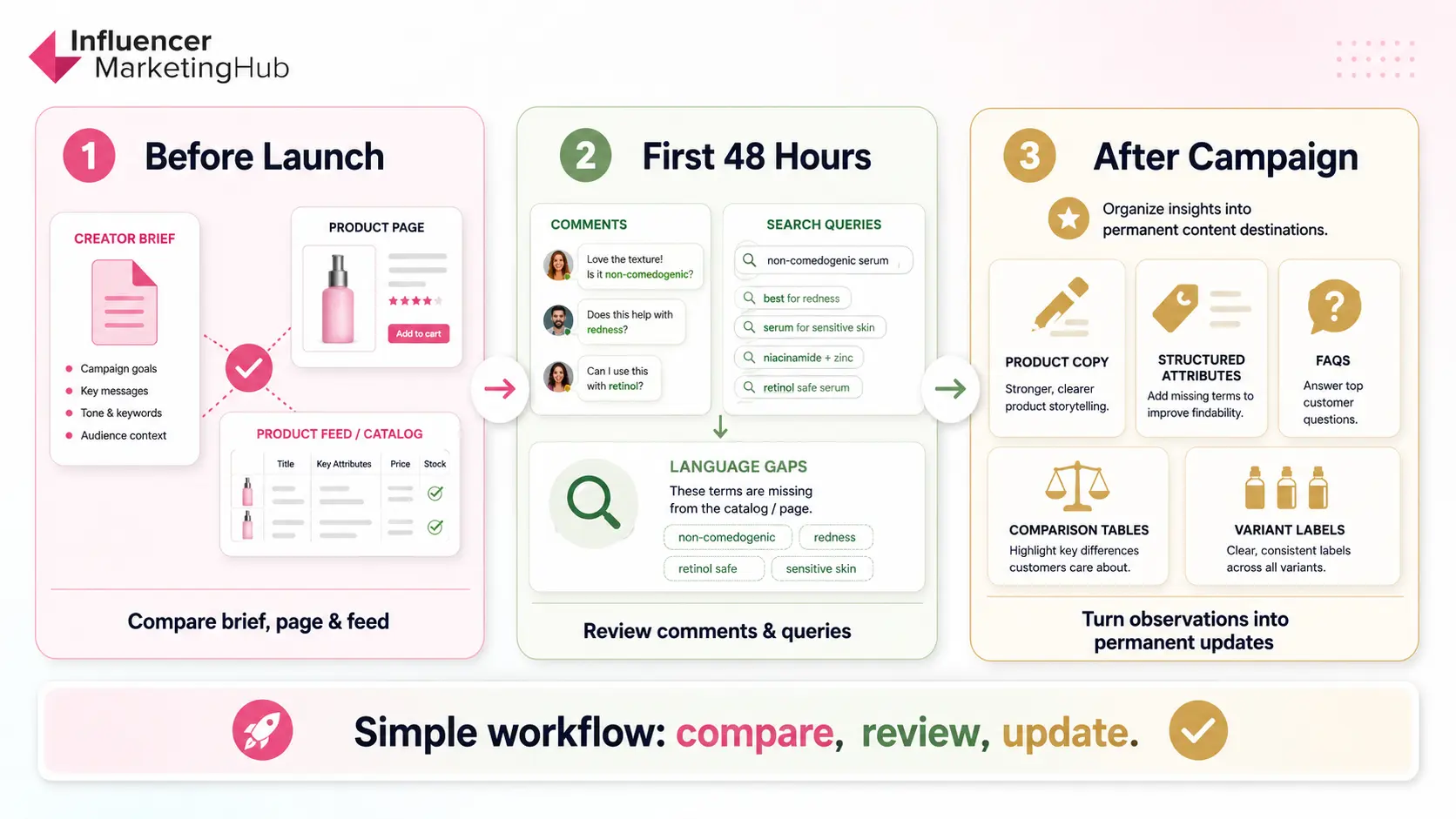
The right response is to build a disciplined feedback loop between creator work and catalog operations.
Start with the language that repeats across creator content, customer questions, product comments, search behavior, and support interactions. Identify the phrases that signal actual buying intent. Then determine whether the site, product information management system, structured data, and merchant feed can answer those phrases accurately.
If creators repeatedly explain that a product is better for a particular use case, that is not just a creative observation. It is a product-discovery attribute. If buyers repeatedly ask whether an item fits, works with, supports, or resembles something specific, that is not just customer-service noise. It is an instruction for the catalog.
This is campaign-to-catalog alignment. It means every major creator campaign should leave the brand with more than reach and content assets. It should improve the product knowledge that future buyers, search systems, and AI assistants can use.
We would operationalize it in four moves:
- Before a campaign, audit the product pages and feeds for the attributes the brief is likely to surface.
- During the campaign, capture recurring buyer language without mistaking subjective creator opinion for unsupported product fact.
- After the campaign, add verified, useful attributes to the product knowledge layer where they can be retrieved outside the original post.
- Test whether the product can be found through realistic conversational queries across Google Search, AI Mode, AI Overviews, ChatGPT, Gemini, Perplexity, Amazon, and merchant surfaces.
The crucial distinction is between extracting useful demand signals and inventing claims. A creator may express a preference. A catalog must state verified product facts. The system works when the brand captures the buyer’s language while maintaining factual discipline about what the product is and does.
AI visibility is not the metric. AI-mediated discovery is.
There is another mistake spreading quickly: treating AI presence as if it were the outcome.
A brand can appear in an answer and still fail the buyer. It can be cited for a broad question yet disappear when the shopper adds the attributes that actually determine purchase. It can show up in a single prompt, then lose the shortlist when the conversation turns to fit, compatibility, price, availability, color, or a specific use case.
In Semrush, a visibility chart may be useful. So may a record of citations or answer mentions. But AI visibility alone is not a growth metric. It is a leading indicator. The business outcome is whether the brand remains discoverable as a buyer’s question becomes more specific and whether that discovery produces qualified referral behavior and revenue.
That requires a more useful measurement model. Run persona-based, multi-turn simulations that reflect how people actually narrow a decision. Track whether the product is retrieved, cited, accurately described, and retained on a recommendation shortlist. Record where an AI system gives an incorrect answer, omits a decisive attribute, or recommends a competing item because the product feed lacked usable detail.

That correction rate matters. Every correction reveals a gap between the product knowledge the brand owns and the product knowledge the market needs. But AI measurement should not stop at the answer. Connect these leading indicators to downstream self-reported attribution, referral behavior, and revenue. The goal is not to win a screenshot. The goal is to make discovery produce a purchase path the company can understand and improve.
But AI measurement also cannot become an excuse for a new reporting theater. A dozen single-prompt tests do not model a real buying journey. The question is whether the brand survives the progression from broad category interest to specific product constraints. That is where incomplete data gets exposed.
Creator commerce is becoming a knowledge architecture problem
The competitive shift is not primarily about buying ads inside large language models. Google Ads will remain part of the commercial mix, but the deeper advantage is moving toward agent-ready product data, consistent brand knowledge, and accurate information that can power recommendation and checkout flows.
As AI systems synthesize plain-language answers, the identity gap gets more dangerous. What a creator says, what the brand says, what search indexes, what the merchant feed contains, and what the buyer needs must increasingly resolve to the same product truth. When those layers diverge, the brand loses control of its own meaning.
That is why audience ownership matters here. The brand does not own a creator’s post, a platform’s recommendation surface, or an AI assistant’s interface. It can own the product knowledge, the product page, the merchant feed, the structured data, and the direct destination that turn external attention into durable discovery.
Creators still matter enormously. They may matter more, not less, because they give products the emotional and practical language that buyers trust. But the creator should be the beginning of the discovery loop, not the only place where the product makes sense.
TL;DR
Creator videos create demand with context that traditional product catalogs often fail to preserve. As shoppers use AI assistants to ask detailed, conversational buying questions, missing information about fit, compatibility, true color, function, and availability breaks the path from influence to purchase.
The fix is not more creator content or a louder AI visibility campaign. It is a system: align creator briefs with verified product attributes, upgrade product pages and merchant feeds, test multi-turn discovery journeys, and measure whether AI-mediated recommendations lead to qualified visits and revenue.
Distribution beats content when the value created in content can travel. Creator commerce becomes a compounding asset only when the catalog can carry the conversation forward.
Find the channels buyers already trust before competitors own them.
We map your acquisition channels, visibility gaps and distribution constraints, then show where market presence can compound into qualified demand.