How to Turn Slack Questions Into an Approval-First Social Content System
 Julia
Julia
Slack Is Already Telling You What Content to Make
The interesting part of this Slack-to-social workflow is not that AI can draft posts. That is table stakes now. The useful part is that it turns a noisy community conversation into a selective operating system for distribution: questions are found, sorted, grouped, translated into useful public content, and held for human approval before they leave the building.
Across the companies we study, most community-led content still begins with manual scavenging. Someone scrolls Slack, bookmarks a good question, forgets three others, then opens a blank document later in the week and tries to remember what people actually needed. The result is familiar: content is shaped by whoever was loudest that day, not by the recurring questions that reveal real gaps in understanding.
A workflow that reads four Slack channels, identifies legitimate questions, archives them in Notion, clusters repeated issues, and prepares posts for Buffer changes that equation. It does not replace a community manager. It gives the community manager a durable memory, a prioritization layer, and a route from private support signal to public distribution.
Get practical tips to manage marketing without adding noise.
Short field notes on positioning, distribution and turning expertise into demand. Written for founders and operators, not marketers chasing trends.
[INFO_TABLE]
Product/Service: Approval-first Slack-to-social content workflow
Input: Questions from four Slack community channels
Extraction Layer: Gumloop with GPT-5.4 Mini
Knowledge Archive: Notion
Clustering Layer: Claude Opus
Distribution Layer: Buffer scheduling for X and Threads
Control Point: Human approval before replies and public posts are published
Price: TBA – depends on automation usage, AI credits, and connected tools
[/INFO_TABLE]
The details that matter are not the individual model names. Gumloop, GPT-5.4 Mini, Claude Opus, Notion, and Buffer can all be substituted over time. The system design is the asset: capture community demand close to the source, separate private support from public education, preserve an approval gate, and push finished work into a scheduling environment where it can actually be distributed.
The Job Is Not “Write More Posts.” It Is “Stop Losing Demand Signals.”
Community questions are unusually valuable inputs because they arrive with context. They show where a member is stuck, the language they use to describe the problem, and often the objection preventing them from taking the next step. That is more useful than another generic brainstorm about topical content. A question asked once may deserve a direct reply. A question asked six times is usually a candidate for a post, a help article, an onboarding improvement, or a product decision.
It took many teams too long to recognize that a community is not just a retention channel. It is a discovery channel. The most useful questions should influence what the company publishes, explains, ships, and repeats. If the community is producing valuable intelligence but it stays trapped in ephemeral threads, the company is paying for insight without building an asset from it.
That is why Notion plays a more important role here than “somewhere to save ideas.” It becomes the operating archive. Every captured question can be retained alongside its channel, theme, response status, and eventual content outcome. Over time, that archive makes patterns visible: recurring confusion, missing documentation, misunderstood positioning, and questions that deserve a better answer than a one-off Slack reply.
How the Workflow Creates Leverage Without Automating Judgment
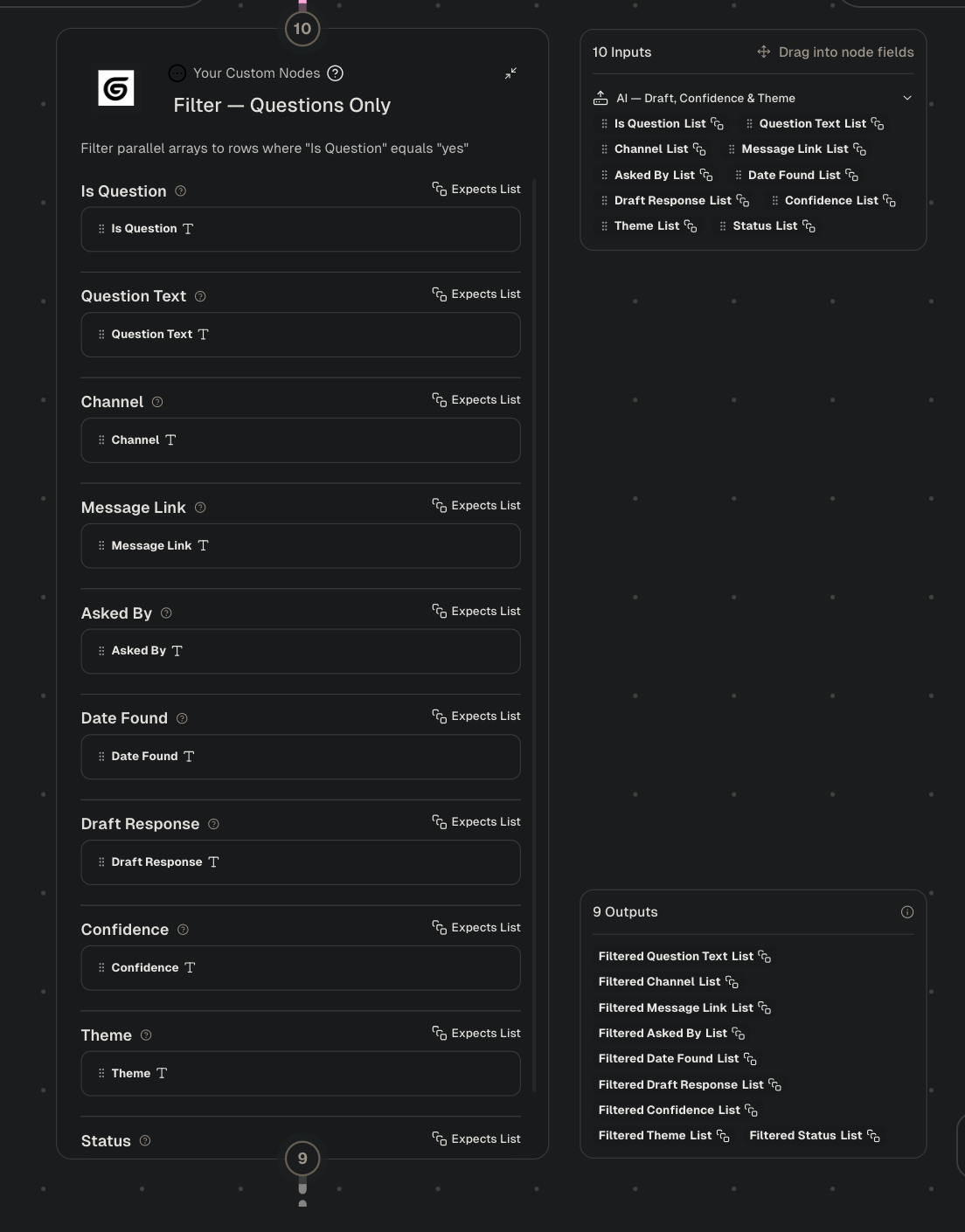
The first layer scans the four selected community channels and extracts real questions from the stream of conversation. This distinction is essential. Slack is full of acknowledgements, jokes, partial replies, side conversations, and messages that happen to contain a question mark but do not merit action. The extraction layer’s purpose is to create a usable inbox of issues, not an impressive-looking pile of AI output.
From there, the workflow drafts a reply to each real question for approval before it is sent. This is the right use of automation. It removes the blank-page delay and the hunt for context while keeping the response under human control. A reply in a community carries more than factual information; it carries tone, judgment, relationship context, and an implicit promise about how the company operates. That should not be published unattended.

The second layer identifies which questions have value beyond the original thread. Those candidates are rewritten in the operator’s voice and placed in Buffer, ready to be scheduled to channels such as X and Threads. The public post is not a copy-and-paste of a private conversation. It is a cleaned-up answer to a shared concern, framed so people outside the Slack workspace can understand and benefit from it.
That distinction prevents a common automation mistake: treating every internal interaction as content inventory. A healthy system is selective. Some questions belong in Slack because the answer depends on the member’s exact circumstances. Some belong in documentation because they reveal a repeatable support need. Some deserve a public social post because they clarify an idea that a wider audience is already struggling to understand. The workflow should help route the signal, not flatten every signal into a post.
- Slack supplies the raw signal: live language, recurring friction, and requests from an engaged audience.
- AI extraction reduces the scanning burden: it creates a queue of questions worth reviewing.
- Notion preserves institutional memory: the team can see what has been asked, answered, and escalated.
- Clustering exposes repeated needs: similar questions become themes rather than isolated interruptions.
- Buffer turns approved drafts into distribution: useful answers can reach members and prospects who never open Slack.
- Human approval protects quality: the company keeps ownership of its voice, claims, and priorities.
Why Clustering Is the Moment This Becomes a Content Operation
Extraction alone produces a task list. Clustering produces strategy. A single question is a support event; a cluster of similar questions is evidence of a broader content gap. Claude Opus is used here to group similar issues, creating a clearer view of what deserves a more durable answer. That could become a short post, a thread, an onboarding email, a FAQ update, a product walkthrough, or a deeper educational asset.
This is the same operating principle behind stronger SEO and AI search workflows. Search Console can show where people are finding a company and where the existing pages fail to satisfy demand. AI Overviews create another layer of complexity because brand visibility can vary by assistant, country, and prompt phrasing. A one-time content plan cannot keep up with an environment where the questions, answers, citations, and recommendations are shifting.
Community conversations add a first-party version of that intelligence. They show what people ask after they have encountered the company, the product category, or its content. If search data tells a business what people look for, community data tells it where understanding breaks down once people arrive. Combining those signals creates a more complete discovery system: query demand, community friction, content gaps, and distribution opportunities feeding one another.
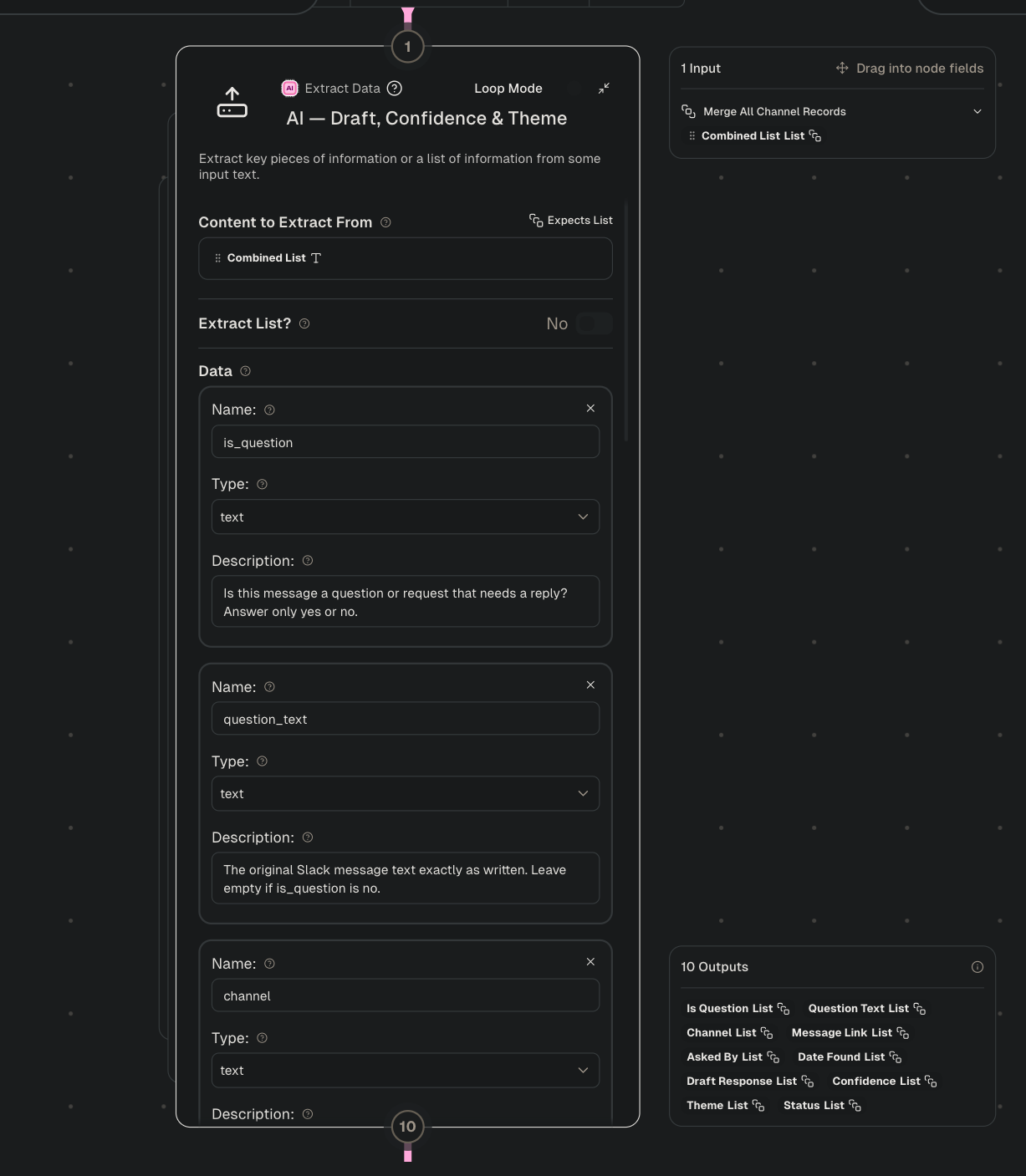
The practical lesson is simple: do not ask an AI model to invent a weekly content calendar from thin air. Give it a corpus of real questions, then use it to identify repetition and prepare drafts. The model becomes much more valuable when it works inside a constrained harness with defined inputs, a clear output format, and a person responsible for deciding what goes live.
Approval Is Not the Bottleneck. It Is the Brand Control Layer.
There is a strain of AI marketing advice that treats human review as an unfortunate temporary step. We think that gets the operating model backwards. Approval is where a company decides whether an answer is accurate, useful, timely, on-brand, and appropriate for public distribution. Automation can accelerate preparation. It cannot assume responsibility for the relationship created by the final post.
That matters especially when a post is derived from a community question. The company must remove personal context, avoid exposing private details, and make sure the public version serves a general audience rather than one individual’s situation. It also needs to ensure that the answer sounds like the company, not like a model trying to approximate the company after reading a few prior posts.
The author’s voice is not a cosmetic final pass. It is part of the asset. Authority compounds when an audience repeatedly encounters clear, useful answers in a recognizable point of view. If every draft is generic, interchangeable, or overconfident, the system can create volume while quietly eroding the trust it was meant to build.
Where This Fits in a Modern Visibility Stack
A Slack-to-social workflow is not a complete content strategy, and it should not be treated as one. It is one input system inside a broader visibility stack. Community questions can inform social posts. The strongest clusters can become owned website content. Those pages can be refreshed as data changes, reviewed for Search Console opportunity, and monitored for how the brand is represented across AI-driven discovery surfaces.
That connected system is more resilient than single-channel growth. Social posts reach people where attention is currently concentrated. Slack strengthens the existing community. Searchable content builds a durable asset on owned property. Monitoring AI answers helps the company understand whether it is being mentioned, recommended, cited, or framed accurately as discovery shifts. Each layer catches demand the others miss.
The bigger advantage is operational. A team no longer has to choose between serving its community and maintaining external visibility. One well-designed workflow lets each helpful answer do more work. It still begins with a real member’s need, but it can become a post for quieter members, an explanation for prospective customers, or a recurring theme that informs the next content investment.
✓ PROS
+
Converts real community demand into a repeatable content input
+
Keeps human approval at the point of publication
+
Extends helpful answers beyond people actively checking Slack
✗ CONS
–
Requires disciplined routing so every question does not become a post
–
Needs ongoing review of prompts, drafts, and integrations
–
Does not replace measurement of whether distributed content creates business value
What We Would Build Differently From Day One
We would treat the Notion archive as a decision system, not merely a content database. Every question should have a clear final state: answered in Slack, turned into a public post, added to documentation, escalated internally, or archived as non-actionable. Without those outcomes, the workflow risks becoming another collection of well-organized ideas that never changes the business.
We would also make measurement part of the loop from the beginning. The system can track how many questions are captured, how many repeat, how many become approved posts, and which themes continue to surface after a public answer has been published. That does not prove business impact on its own, but it prevents the team from confusing production volume with learning.
Finally, we would keep the workflow narrow until the review process feels reliable. Start with a limited set of channels, a defined question format, clear categories, and a simple approval queue. Expanding an unreliable system only scales the mess. Systems outperform manual effort only after they make the right work easier to see and easier to decide.
The Verdict: Build the System, Not an AI Content Factory
The strongest idea here is not automated posting. It is the decision to make community intelligence operational. A company that consistently captures questions, identifies recurring gaps, creates useful answers, and distributes those answers across multiple surfaces is building authority from work it is already doing.
For operators managing active communities, this is a sensible system to build on. It reduces the cost of finding the next useful topic, protects the human voice through approval, and gives valuable Slack conversations a life beyond the thread. The constraint is equally clear: it needs ownership. No model, no integration, and no scheduler can decide what your company should stand for in public.
8.5/10
VERDICT
Build this as an approval-first distribution system-its real value is turning overlooked community questions into compounding authority, not generating more posts for their own sake.
Find the channels buyers already trust before competitors own them.
We map your acquisition channels, visibility gaps and distribution constraints, then show where market presence can compound into qualified demand.