How We Would Audit a Blog Producing No Pipeline: We Deleted 79 Posts
 Julia
Julia
A blog that produces no pipeline does not need another publishing sprint. It needs a harder decision: which pages still deserve to represent the company in search, and which pages are making the site less useful, less focused, and harder to trust.
That was the decision behind our own audit. We reviewed 93 posts. We kept 14. We removed 79.
This was not a cosmetic tidy-up, and it was not an attempt to manufacture a neat before-and-after SEO story. The results on traffic, rankings, and pipeline are still TBD. We are not going to claim that deleting content creates a guaranteed lift before the evidence exists.
Get practical tips to manage marketing without adding noise.
Short field notes on positioning, distribution and turning expertise into demand. Written for founders and operators, not marketers chasing trends.
What we can say now is that the blog is no longer trying to be useful to everyone for everything. It has a clearer job: support the themes where we want authority, help the right people discover us, and move them toward something commercially relevant.
The strategic call: shrink the archive before you scale it
The common reaction to a blog that is not producing pipeline is more content. More keywords. More publishing cadence. More briefs handed to a team already maintaining pages nobody can defend.
We would do the opposite first. We would reduce the archive until every surviving page has a strategic reason to exist.
This is not an argument against content. It is an argument against treating content volume as a distribution strategy. A large archive of generic, overlapping, outdated, or off-topic posts does not create authority simply because it is large. It creates more pages to maintain, more possible dead ends for prospects, and more noise around the themes the business actually wants to own.
Visibility compounds when the company is consistently associated with a small set of meaningful ideas. It does not compound because the site has accumulated years of loosely related articles.
Our audit was designed to make that distinction practical. The objective was not to preserve every page that had once been published. The objective was to create a sharper discovery system.
Set the audit goal before opening the spreadsheet
The spreadsheet is where most content audits go wrong. Teams export a long URL list, add performance columns, then start debating individual posts without agreeing on what the blog is meant to do.
That produces the usual outcome: a vague “refresh” backlog, a long list of pages nobody owns, and an archive that stays almost exactly as unfocused as it was before.
We would define the goal in business terms before reviewing a single URL:
- Clarify the core themes the company wants to be known for.
- Remove pages that dilute those themes or compete with stronger pages.
- Create cleaner paths from discovery to the company’s higher-intent pages.
- Stop spending editorial effort maintaining content with no meaningful role.
- Make future publishing decisions against a higher bar.
The goal should not be “save as much content as possible.” It should not be “increase traffic at any cost.” And it should not be “make the dashboard look healthier.”
A blog is part of the company’s distribution infrastructure. Its job is to help the market discover the business, understand its authority, and take a useful next step. If a post does none of those things, preserving it because it exists is not prudent. It is inertia.

Business goal → core themes → page role → keep or remove
Build an inventory that supports decisions, not reporting
Tools are useful here, but they are not the strategy. Google Search Console, Google Analytics, and Screaming Frog can help establish the inventory and surface evidence. None of them can decide whether a page deserves to remain part of the company’s public point of view.
For each post, we would capture only the information needed to make a real decision:
- The URL and the page’s actual topic.
- The core business theme it is meant to support.
- The search intent or discovery role it serves.
- The page it overlaps with, if it targets a similar idea.
- Its performance signals from Google Search Console.
- Its engagement and conversion context from Google Analytics.
- The next meaningful destination available to the reader.
- A final keep-or-remove decision with a written reason.
The important phrase is written reason. A page should not survive because someone says it might become useful someday. If the team cannot explain why it belongs in the business’s future distribution system, the page has not earned a place.
Do not turn this into a vendor comparison or a tooling project. Screaming Frog can help identify the surface area. Google Search Console can show how people find the page. Google Analytics can show what happens after they arrive. The judgment still belongs to the operator running the business.
The keep-or-kill bar we used
We did not create a broad “update everything” category. That category is often where weak content goes to avoid a decision. It sounds responsible, but it usually becomes a warehouse for pages that nobody will meaningfully improve.
Every surviving page had to clear a simple bar:
Core theme → distinct purpose → credible authority → meaningful next step
If a page could not clear that bar, we removed it. That is how a review of 93 posts became 14 retained posts and 79 removed posts.
A page earned a keep decision when it did all four jobs
- It supported a core theme. The topic had to reinforce what we want the company to be known for. A page can be well written and still be strategically irrelevant.
- It had a distinct purpose. The page needed a clear reason to exist alongside every other surviving post. Similar pages targeting the same idea create unnecessary competition and confuse the site’s topical structure.
- It could build authority. The post needed to demonstrate useful judgment, not simply restate information that could be generated, summarized, or answered elsewhere without the company’s expertise.
- It led somewhere meaningful. A reader needed a logical next step. That does not mean every page needs an aggressive sales message. It means the page cannot leave the visitor in a generic content loop with no connection to the business.
The 14 posts we retained were not selected because we were emotionally attached to them or because removing content feels uncomfortable. They survived because they could still contribute to a focused body of work.
A page earned removal when it weakened the portfolio
- It covered a topic outside the company’s strategic territory.
- It repeated or competed with a stronger page on the same subject.
- It was generic enough that it added little original authority.
- It sent readers into an outdated, unclear, or commercially irrelevant journey.
- It existed because a keyword was available, not because the company had a reason to own the conversation.
The mistake we see most often is treating deletion as an extreme measure. It is not. Deleting weak content is normal portfolio management. The extreme move is continuing to publish into an archive that nobody believes in.
Resolve overlap before judging posts in isolation
Content cannibalization is rarely obvious when reviewing one URL at a time. Each article can look reasonable on its own. The problem becomes clear when several posts are trying to answer the same underlying question, rank for the same type of query, or occupy the same place in the buyer journey.
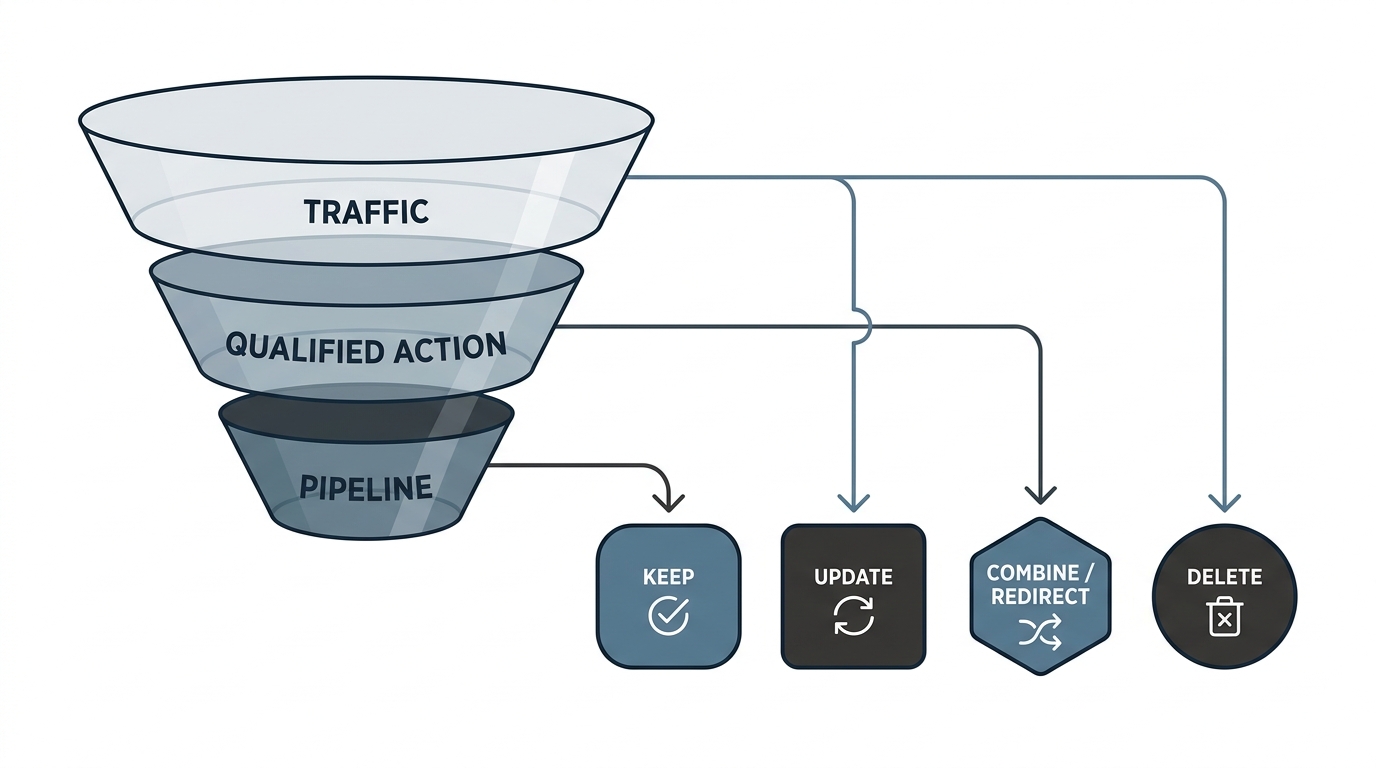
When that happens, the right response is not to preserve all of them and make minor edits. We would decide which page should become the single authoritative resource, then remove the weaker leftovers from the editorial portfolio.
This matters for two reasons. First, multiple overlapping posts can split attention, internal authority, and external signals across pages that should not be competing. Second, it creates a poor reader experience. A prospect who lands on three versions of the same broad article does not gain confidence in the company. They lose time.
Cleaner content architecture creates cleaner journeys. That is not a cosmetic SEO exercise. It is a business outcome. The fewer irrelevant detours a high-intent visitor encounters, the more likely they are to reach content that helps them evaluate the company properly.
Use performance data as evidence, not as the decision-maker
A post with traffic is not automatically a keeper. A post with low traffic is not automatically a removal.
Google Search Console can show whether a page earns search visibility and the kinds of queries connected to it. Google Analytics can provide context around what visitors do next. Those are useful signals. But neither replaces the strategic question: does this page help the company own a topic that matters?
A high-traffic article can still be a poor asset if it attracts the wrong audience, leads nowhere relevant, and weakens the company’s topical focus. A quieter post can be worth retaining if it demonstrates real expertise on a core theme and supports a valuable discovery path.
The anti-content-mill standard is simple: do not keep a page merely because it can attract attention. Keep it because the attention strengthens authority, distribution, or pipeline.
That distinction becomes more important as AI Overviews and AI Mode change how informational searches are resolved. Generic explanatory content has a weaker role when the search journey can end with a synthesized answer. The pages worth protecting need a clearer reason to be chosen, remembered, and acted on.
Do not refill the archive with more generic articles
Removing 79 posts creates a temptation to restore the old volume as quickly as possible. That would miss the point.
The next content plan should be more selective than the last one. Every new page needs a defined role in the company’s discovery system before it is commissioned. If it does not reinforce a core theme, create useful authority, or lead the right reader toward a meaningful next step, it does not belong in the plan.

The advanced move is to look beyond purely informational articles where the business has a genuine utility advantage. Free, single-purpose tools can win durable SEO traffic, especially as AI responses reduce demand for generic informational content. A useful tool is not a loophole for publishing more assets. It must still serve a specific problem, reinforce a core topic, and fit the company’s broader distribution strategy.
That is the broader lesson: content is not the asset. The asset is a system that makes the company easier to discover, easier to trust, and harder to ignore.
Troubleshooting the decisions that usually stall an audit
The team wants to keep everything “just in case”
This is the most common failure point. “Just in case” is not a role. It is a refusal to prioritize. Return to the original goal and require a clear explanation of how the page supports visibility, authority, discovery, or pipeline.
If the explanation is hypothetical, the page has not earned retention.
A page has traffic but no business relevance
Do not let traffic alone override strategy. A large audience that will never become the right audience can consume editorial resources while distracting the company from topics it should own. The question is not whether a page can be found. The question is whether being found for that page makes the company stronger.
Several posts are similar, but nobody wants to choose a winner
Choose the page that best represents the future authority you want to build. Do not preserve every variation to avoid conflict. A domain becomes clearer when it has one strong answer for a subject instead of several partial answers competing for the same attention.
Leadership expects immediate proof that the deletions worked
Be direct: the immediate achievement is a more coherent portfolio, not a fabricated performance win. Our own results are TBD. The right standard is to observe what happens after the business has created a cleaner content system, not to attach invented causality to the act of removing pages.
What done right looks like
A successful audit does not end with a shorter spreadsheet. It ends with a blog where every surviving post has a defensible purpose and every future idea faces a higher standard.
For us, that meant reviewing 93 posts, retaining 14, and removing 79. It meant accepting that deletion is part of building authority. It meant refusing to mistake an oversized archive for a distribution advantage.
The result we are building toward is not simply more content performance. It is a stronger discovery system: fewer distractions, clearer topical authority, better paths for serious prospects, and a content operation that supports the business rather than merely producing output.
TL;DR
- Audit a blog against business goals before reviewing individual URLs.
- Treat content as distribution infrastructure, not an inventory that must be preserved.
- Use Google Search Console, Google Analytics, and Screaming Frog for evidence, not judgment.
- Keep only pages that support a core theme, have a distinct role, build authority, and offer a meaningful next step.
- Remove off-topic, generic, overlapping, outdated, and commercially disconnected posts.
- Do not use deletion as a shortcut to claim SEO results. Our results remain TBD.
- Use the cleared capacity to build fewer, stronger assets that improve discovery and authority.
Find the channels buyers already trust before competitors own them.
We map your acquisition channels, visibility gaps and distribution constraints, then show where market presence can compound into qualified demand.