How We Would Decide Whether a Meta Campaign Is Worth Scaling
 Julia
Julia
A campaign is not scalable because its blended results look good
The expensive mistake in Meta advertising is treating early efficiency as proof of scalable demand. A campaign can look excellent at a modest budget, then fall apart as soon as spend rises-not necessarily because the creative stopped working, but because the original result was carrying more remarketing credit than acquisition power.
Warm audiences make this especially easy to miss. Site visitors, social engagers, email subscribers, and past buyers already know the business. When Meta receives generous conversion credit through seven-day click, one-day view, or engagement-based attribution, a campaign can look stronger than the new-customer demand it is actually creating.
Our recommendation is straightforward: do not scale a Meta campaign based on blended attribution. Qualify it with one-day-click results and separate prospecting performance from remarketing before increasing spend. If the campaign remains strong when that warm-audience credit is removed, it has earned the right to scale. If it does not, more budget will usually expose the weakness rather than solve it.
Get practical tips to manage marketing without adding noise.
Short field notes on positioning, distribution and turning expertise into demand. Written for founders and operators, not marketers chasing trends.
This is a distribution decision, not a reporting preference. A company that can reliably reach and convert new audiences has an acquisition engine. A company relying mainly on people who already know it has a remarketing engine. Both can be valuable-but they should not be confused.
What you are actually trying to validate
Before scaling, the question is not, “Did Meta report conversions?” The question is, “Would this campaign still perform if we asked it to reach people who have not already visited, engaged, subscribed, or purchased?”
That distinction matters because a campaign can succeed at low spend while it is efficiently finding people already close to converting. At that stage, audience saturation is low and the warm pool is easy to reach. Raise the budget, and Meta must expand delivery beyond that pool. The reported performance then drops because the campaign is finally being tested against colder demand.
In practice, the decision path should be:
Baseline attribution → isolate warm audiences → inspect 1-day-click prospecting → qualify demand → scale spend
Most teams skip the middle of that process. They see a strong blended return, raise budget, and discover too late that they were scaling attribution credit rather than scalable customer acquisition.
Prerequisites: define the reporting view before you touch budget
You need two reporting views before making a scale decision: an attribution view that reflects the business’s normal measurement approach, and a stricter view used specifically to qualify whether the campaign can expand.
- Operating attribution view: A common default is seven days after a click and one day after a view. The window should reflect the actual purchase cycle, rather than an arbitrary platform default.
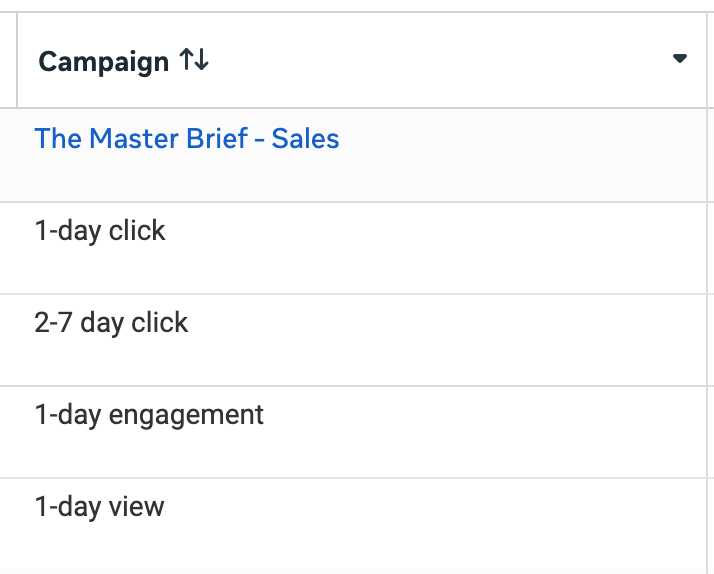
- Scaling qualification view: One-day-click conversion results only. Ignore view-through, engage-through, and seven-day-click conversions when deciding whether a campaign deserves more budget.
- Audience view: Prospecting or new-audience performance separated from remarketing and other warm audiences.
Do not use the broader operating view as your scale gate. It can remain useful for understanding the wider contribution of advertising, but it is too easy for warm-audience activity to inflate the apparent strength of a campaign. The scaling decision needs a higher standard.
Step 1: Use one-day click as the scale qualification metric
Start with Meta’s breakdown by attribution setting and isolate the results credited to a one-day click. This is the number we would use to decide whether performance is strong enough to support additional spend.
The reasoning is simple: a one-day click is a more demanding signal than a view-through conversion, an engagement-based conversion, or a conversion credited several days after the ad click. It does not eliminate attribution uncertainty, but it reduces the amount of credit that can be captured by brand familiarity and remarketing exposure.
Most guides tell advertisers to look for a stable blended cost per conversion or return on ad spend. We would not accept that alone. A blended number can hide the exact condition that causes a campaign to fail at scale: the campaign converts warm users efficiently but cannot generate enough immediate, click-led conversion activity from a colder audience.
The practical judgment is this: if the campaign only looks attractive when seven-day click, one-day view, or engagement credit is included, it has not yet demonstrated scalable acquisition performance.
Step 2: Separate prospecting from remarketing before judging demand
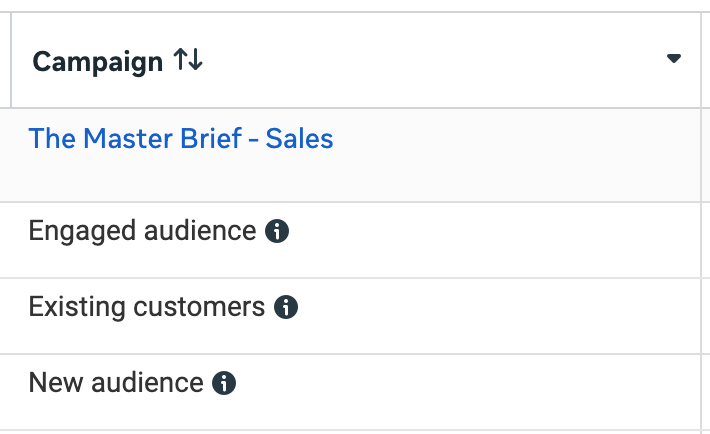
Next, evaluate new-audience performance separately from warm-audience performance. The warm comparison group should include a 180-day website custom audience covering all site visitors, alongside the full email list. This creates a clearer distinction between people who already have a relationship with the business and people who are being reached as prospective customers.
Remarketing should not be treated as a failure. It often converts efficiently because it is designed to capture demand that already exists. The mistake is allowing that efficiency to stand in for prospecting performance.

We would look at the results in two separate buckets:
- Warm audiences: Website visitors, engagers, email contacts, and other people already familiar with the brand.
- Prospecting or new audiences: People outside those known-audience groups, where the campaign must create or capture fresh demand.
This distinction is where the real scaling verdict emerges. If warm audiences drive the majority of credited conversions while prospecting is weak on a one-day-click basis, the campaign is a remarketing success-not yet a scalable acquisition campaign.
Step 3: Compare the two views before increasing spend
Now compare the campaign’s blended result with its one-day-click prospecting result. You are not looking for a prettier dashboard. You are looking for evidence that the campaign’s core performance survives stricter measurement.
A campaign is worth scaling when its strong result persists after both filters are applied:
- It continues to produce convincing one-day-click conversion performance.
- That performance remains visible in prospecting or new-audience reporting, not only among site visitors, email contacts, engagers, or past buyers.
If both conditions hold, the campaign is demonstrating more than efficient credit collection. It is showing that the offer, creative, audience strategy, and conversion path can work beyond the people already closest to buying.
If either condition fails, do not respond by simply spending more. A bigger budget does not make weak prospecting stronger. It increases the amount spent while Meta searches for conversions farther away from the warm audience that made the campaign look good in the first place.
Step 4: Scale in phases, not as a declaration of confidence
Once a campaign qualifies, increase budget through a phased rollout. The purpose is not caution for its own sake. It is to gather enough evidence to see whether performance continues to hold as delivery expands.
A phased approach gives the campaign room to reveal whether it can continue finding viable prospects as spend grows. It also gives the business a clearer read on the relationship between bidding, delivery, conversion quality, and audience reach.
The standard should remain the same throughout: monitor prospecting results under the one-day-click lens. Do not let a rising total conversion count distract from a weakening new-audience signal. Total reported conversions can increase while the underlying acquisition efficiency deteriorates.
Where scaling decisions usually go wrong
The campaign was tested only at small scale
Small budgets can make a campaign look unusually efficient because the platform can concentrate delivery on the most familiar, most responsive portion of the available audience. That result is not useless, but it is incomplete. The campaign has not proven that it can reach beyond the easiest conversions.
Remarketing and prospecting were reported together
This is the most common analytical error. When warm and new audiences sit inside one performance number, strong remarketing masks weak acquisition. The reported campaign result becomes impossible to use as a scaling signal because it does not tell the operator where the conversions came from.
View-through and long-window credit drove the decision
Generous windows can be appropriate for broader attribution analysis when they match the purchase cycle. They are not a reliable basis for deciding whether more spend will produce more efficient acquisition. For that decision, isolate one-day-click results.
Measurement gaps were treated as proof of performance
Mobile attribution has real constraints. ATT, SKAdNetwork, and cross-platform identity gaps limit what generic web measurement can connect at the individual level. That does not justify relying on looser platform credit. It makes disciplined segmentation and a consistent qualification view more important.
The advanced move: treat remarketing as its own revenue system
Strong operators do not try to make one blended Meta number answer every question. They separate demand capture from demand creation.
Remarketing monetises attention the company has already earned through its website, content, customer relationships, and email audience. Prospecting expands distribution by reaching people who do not yet know the brand. Both matter, but they compound in different ways.
Your email list and website visitor base are owned-audience assets. They should be measured as such—not allowed to disguise whether paid prospecting can build a larger market. This is how a business avoids fragile, single-channel growth: it knows which activity is converting existing attention and which activity is creating new opportunities for discovery.
TL;DR: scale proven acquisition, not blended attribution
- Do not increase Meta spend because blended campaign reporting looks efficient.
- Use Meta’s attribution-setting breakdown to isolate one-day-click results for the scaling decision.
- Evaluate prospecting or new-audience performance separately from remarketing, using a 180-day website visitor audience and the full email list to identify warm users.
- Ignore view-through, engage-through, and seven-day-click conversions when deciding whether a campaign can scale.
- Scale only when strong one-day-click performance persists within prospecting-focused reporting.
- Use a phased rollout and keep validating the same strict signal as budget expands.
Done right, scaling is not a bet on a dashboard. It is evidence that the business can turn paid distribution into new demand—and that is the performance signal worth funding.
Find the channels buyers already trust before competitors own them.
We map your acquisition channels, visibility gaps and distribution constraints, then show where market presence can compound into qualified demand.