How We Would Write LinkedIn Posts People Stop, Read, and Share
 Julia
Julia
Publishing regularly on LinkedIn is not a content strategy. It is only a production habit.
The businesses that build meaningful visibility treat every post as a distribution asset. It needs to earn attention from the right person, hold that attention long enough to prove its value, and leave the reader with something useful enough to share.
That is the strategic job behind a LinkedIn post: not to fill a calendar, generate a few passive likes, or announce that the company exists. LinkedIn increasingly rewards knowledge sharing and quality conversations. Comments, saves, and shares matter because they indicate that the post helped someone do, understand, or articulate something better.
Get practical tips to manage marketing without adding noise.
Short field notes on positioning, distribution and turning expertise into demand. Written for founders and operators, not marketers chasing trends.
Our recommendation is to build posts around the Triple S model: Stop, Stay, Share. But do not start there. The strongest hooks in the world cannot rescue a post written for an undefined audience with no meaningful outcome in mind.
Start with the business decision, not the post idea
The mistake we see most often is founders writing from their own perspective: what happened this week, what the team launched, what they believe, what they are working on. Those can become good posts, but only after they are translated into a reader’s problem, decision, or ambition.
Before writing, establish three things:
- A specific ICP: define the kind of operator the post is for. “Founders” is too broad. A founder navigating a plateau, an ecommerce owner trying to improve discovery, or a CEO building authority in a crowded category is more useful.
- A 30-day transformation: decide what that person should understand, change, or be able to act on within the next month after engaging with your content.
- A reader-first angle: frame the insight around the cost, opportunity, or decision in the reader’s world-not the company’s internal activity.
This creates a practical operating sequence: Specific ICP → 30-day transformation → reader problem → useful post → earned distribution.
Without this foundation, LinkedIn content turns into generic consistency: broadly motivational, lightly informative, and commercially forgettable. It may create activity, but it does not create authority.
Use a personal profile as the lead distribution surface
For thought leadership, personal profiles outperform company pages. That is not a reason to abandon the company page; it is a reason to stop expecting a brand account to carry the full weight of expert-led visibility.
People follow people with a clear point of view. A founder, operator, or internal expert can explain the hard-won logic behind a decision in a way a company page rarely can. The personal profile becomes the front door for authority. The business benefits when that authority is consistently connected to the company’s category, expertise, and commercial point of view.
The better system is to develop focused expert voices around a small number of recurring themes. Do not chase every LinkedIn trend. Build recognition through repeated usefulness in the areas where your company has earned insight.
What this prevents: a feed full of disconnected opinions that may attract attention but never make the company easier to discover, trust, or buy from.
The Triple S model: Stop, Stay, Share
The Triple S model works because it follows the reader’s actual experience. First they decide whether to pause. Then they decide whether the post deserves their attention. Finally, they decide whether the insight is useful enough to carry into their own network.

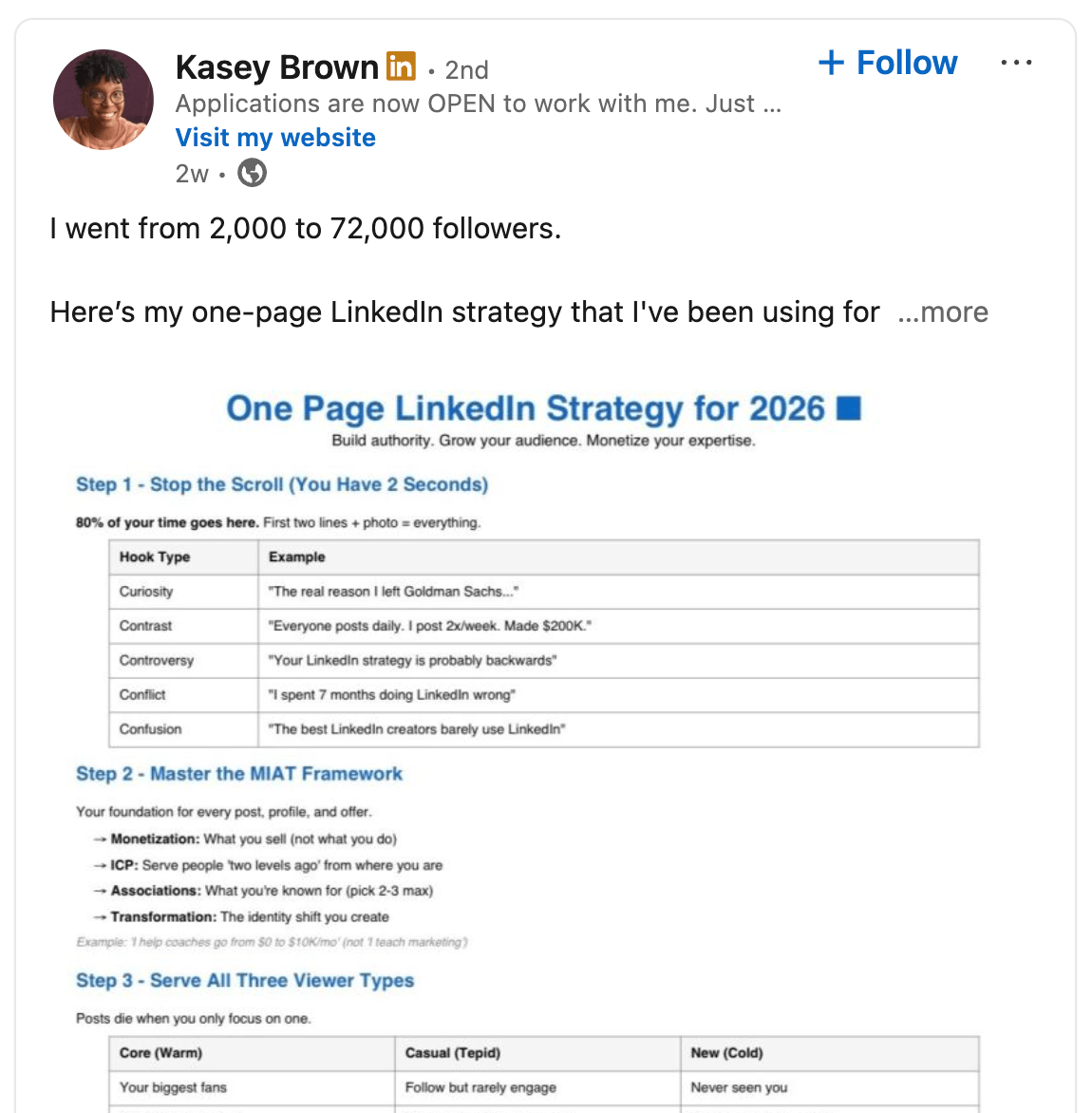
1. Stop: earn the pause with a real tension
The first line and visual element have one job: make the right reader stop scrolling. This is not permission to use shock tactics, vague contrarianism, or manufactured urgency. It is a requirement to lead with a tension that is immediately relevant to your ICP.
Strong hooks usually expose a gap between what the reader is doing and what the situation actually demands. They make a clear claim, name an expensive mistake, or surface a decision the reader has been avoiding.
- Lead with a meaningful business problem, not a broad topic.
- Make the opening specific enough that the intended reader recognises themselves.
- Use an attention-grabbing image only when it strengthens the argument rather than decorating it.
- Give the reader a reason to continue before explaining every detail.
Do not use a generic hook and hope the body creates relevance later. The first few lines are where relevance is decided. A post that begins with a vague observation about growth, leadership, or marketing asks the reader to do too much work.
The judgment call: write for the person you need to reach, not the largest possible audience. Narrow relevance is more valuable than broad indifference.
2. Stay: make the “see more” click worth it
Getting the click is not the win. It is the handoff. Too many posts begin with a sharp claim, then collapse into long blocks of context, self-congratulation, or a conclusion the reader could have predicted from the opening.
Keep tension after the “see more” break. Develop the claim with a clear sequence: establish the problem, explain the overlooked mechanism, and show the practical implication. The reader should feel that each paragraph earns the next.
- Use short paragraphs so the post can be scanned without becoming shallow.
- Separate one idea from the next instead of stacking unrelated thoughts.
- Use structure to guide the reader from tension to insight to action.
- Test readability on mobile before publishing. LinkedIn is experienced in the feed, not in a desktop writing document.
Mobile readability is strategic, not cosmetic. Dense copy makes a useful idea feel difficult. Clear spacing and a visible argument make the same idea easier to absorb, save, and share.
Do not confuse brevity with clarity. A short post with no argument is just a slogan. A longer post can hold attention when every line moves the reader toward a sharper conclusion.
3. Share: give readers language and leverage
Shares are not earned by ending with a generic request for engagement. They are earned when the reader sees a useful idea they want associated with their own reputation, team, or audience.
End with a concrete takeaway. It can be a reframing, a decision rule, a warning, or a compact framework. What matters is that the reader can carry it forward without needing the rest of the post explained again.
The strongest conclusion does two things at once:
- It resolves the tension introduced in the hook.
- It gives the reader a practical idea worth returning to, discussing, or reposting.
A weak CTA asks for attention. A strong ending gives the reader a useful conclusion and lets the resulting conversation emerge from its value.
Write without outsourcing the point of view
AI can make it easier to produce polished-looking content. It cannot decide which reader matters to your business, what transformation your expertise can credibly create, or which tension is worth owning in public.
That judgment is the asset. When every post sounds like a cleaned-up version of familiar marketing advice, the company gains volume but loses distinction. Authority comes from recognising the thing others miss, naming it plainly, and returning to it with enough consistency that the market begins to associate the idea with your business.
Write from observed customer questions, operational decisions, recurring objections, and the trade-offs your company understands better than the market. That is where original LinkedIn content comes from. It does not require artificial volume. It requires a real perspective.
Measure whether the post is building distribution
Do not judge a LinkedIn content strategy on likes alone. Likes can signal acknowledgement; comments, saves, and shares better indicate that an idea created a useful conversation or remained valuable after the initial read.
Use LinkedIn activity to learn which topics create meaningful engagement among the audience you want. Use Google Analytics to see whether that attention produces stronger on-site behaviour over time. If LinkedIn Ads are part of the wider growth system, use organic posts to sharpen the language and problems that deserve paid distribution rather than treating paid and organic as separate worlds.
The goal is not to make every post perform identically. The goal is to identify the recurring ideas that attract the right people, create quality conversations, and strengthen the company’s discoverability.
Troubleshoot the failure points before they become a content habit
The post gets impressions but no meaningful engagement
The opening may be broad enough to attract attention but too generic to trigger recognition. Tighten the ICP and make the tension more commercially specific. A reader should know within seconds whether the post was written for someone in their position.
Readers click “see more” but do not stay with the post
The hook likely promised more than the body delivered. Remove unnecessary context, break the argument into readable sections, and make the central insight arrive sooner. The body must reward attention, not delay the payoff.
The post receives likes but is not saved or shared
The conclusion may be agreeable without being useful. Replace the soft ending with a sharper takeaway that gives the reader a decision rule, a practical reframing, or language they can use in their own work.
The content feels active but does not build authority
The themes are probably too scattered. Return to a smaller set of topics where your company has a credible point of view. Visibility compounds when the market can remember what you are known for.
The advanced move: turn proven posts into an authority system
A winning post should not be treated as a one-time event. When an idea earns quality comments, saves, or shares, it has revealed something important about the audience’s unresolved needs.
Build from that signal. Revisit the same strategic tension from another angle. Explain the trade-off behind it. Turn the question in the comments into a deeper point of view. Connect it to the product, service, or operating model only where that connection is genuinely useful.
This is how content becomes a system rather than a stream of isolated posts. The company develops a body of public thinking, the audience learns what it can rely on you to explain, and every useful contribution makes the next one easier to discover.
TL;DR: the LinkedIn posting system we would use
- Define a specific ICP before choosing a post topic.
- Set the 30-day transformation your content should help create.
- Use personal profiles to lead thought leadership and expert-led distribution.
- Stop: open with a specific, relevant tension.
- Stay: deliver on the hook through clear, mobile-readable structure.
- Share: finish with a concrete takeaway, not an engagement plea.
- Track quality conversations, saves, and shares alongside broader attention.
- Repeat the ideas that reveal genuine audience demand and turn them into a recognisable authority platform.
Done right, LinkedIn content does more than fill a feed. It creates a durable discovery channel: one that makes the right people more likely to recognise your expertise, trust your judgment, and carry your ideas into rooms you cannot reach directly.
Find the channels buyers already trust before competitors own them.
We map your acquisition channels, visibility gaps and distribution constraints, then show where market presence can compound into qualified demand.