The Indexing Mistake That Cost Us a Quarter of Our Google Visibility
 Julia
Julia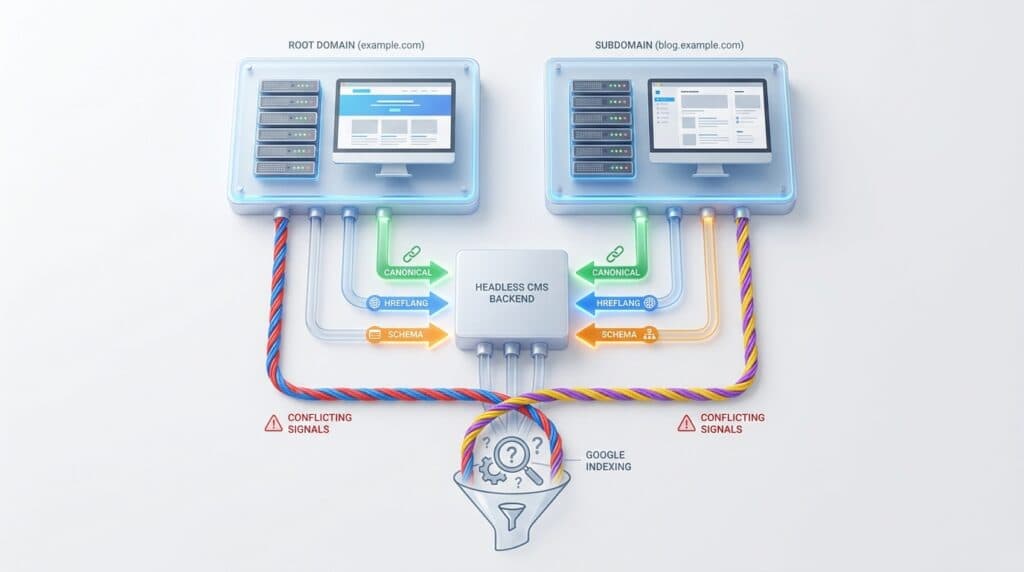
We run our visibility systems on our own property, at our own risk. That matters because there is nowhere to hide when a technical decision damages performance. No client handover. No agency report that explains away a decline with vague language about volatility. No convenient story about an algorithm update.
When our Google visibility dropped by roughly a quarter, the problem was not that we had stopped publishing. It was not a content-quality issue. It was not a mysterious penalty. We had created an indexing conflict between our root domain and a subdomain used in our headless CMS setup.
In plain terms, we allowed one body of content to exist across two hosts without enforcing a single, reliable version for search. Google had multiple paths into substantially the same content ecosystem. Our architecture had split the signals that should have compounded in one place.
Get practical tips to manage marketing without adding noise.
Short field notes on positioning, distribution and turning expertise into demand. Written for founders and operators, not marketers chasing trends.
That is the failure. We own it.
We treated an indexing architecture problem as a publishing problem
The most expensive SEO mistakes are often boring. They are not dramatic hacks or reckless link schemes. They are the quiet infrastructure errors that sit underneath a publishing operation while everyone celebrates a better site build, a faster workflow, or a cleaner CMS implementation.
Headless systems can create exactly this kind of blind spot. They give teams flexibility. Content can be managed separately from the front end. Different systems can serve different purposes. A business can move faster without forcing every workflow through one traditional publishing stack.
But flexibility is not the same as coherence.
Search does not care whether a split architecture felt elegant to the team that built it. Google sees URLs, hosts, internal links, canonicals, sitemaps, redirects, rendered HTML, and repeated signals over time. If those signals disagree, the business has a discovery problem.
And discovery is a business function. It is not an implementation detail to be delegated indefinitely to whoever happens to own the CMS or whoever last touched Search Console.
Our mistake was allowing the subdomain and root domain to behave as competing homes for content that should have reinforced one domain-level authority system. The subdomain was not merely an internal technical component. It had become visible to crawlers and indexation systems in ways that weakened consolidation.
The result was predictable in hindsight. Instead of building one increasingly clear set of search signals around the root domain, we had distributed them across two hosts. That fragmentation cost us roughly a quarter of our Google visibility before recovery began.
Key takeaways
- Search visibility compounds only when pages, metadata, canonicals, sitemaps, and redirects reinforce one authoritative domain.
- A subdomain can become a competing indexation surface if it is crawlable, discoverable, or allowed to publish conflicting signals.
- Canonical tags alone are not a strategy. They must be absolute, consistent, rendered in the raw HTML, and supported by redirects and sitemap logic.
- Search Console is not a reporting destination. It is an operational control point for discovering whether Google is seeing the site you believe you have built.
The real mistake was splitting authority
There is a lazy version of this story that says subdomains are bad for SEO. That is not the lesson.
The lesson is that a subdomain is a separate surface in the eyes of search systems, and it must be treated with that level of seriousness. If it is part of a deliberate strategy, it needs a clear role. If it is only a technical by-product of a CMS architecture, it should not be allowed to become an alternate version of the business in search.
Our root domain was supposed to be the source of authority. That was where the public-facing experience belonged. That was where our content was meant to accumulate relevance, links, internal connections, and recognition over time.
But the headless CMS arrangement created another host that could participate in indexing. This is the kind of failure that can look harmless at first. A few pages surface unexpectedly. A canonical is missing on a template. A sitemap points somewhere it should not. Metadata is generated in more than one place. An old URL remains reachable. A crawler gets a response from the subdomain when it should have been sent cleanly to the root domain.
None of those failures needs to be catastrophic on its own. Together, they create ambiguity. And ambiguity is expensive when your business depends on discovery.
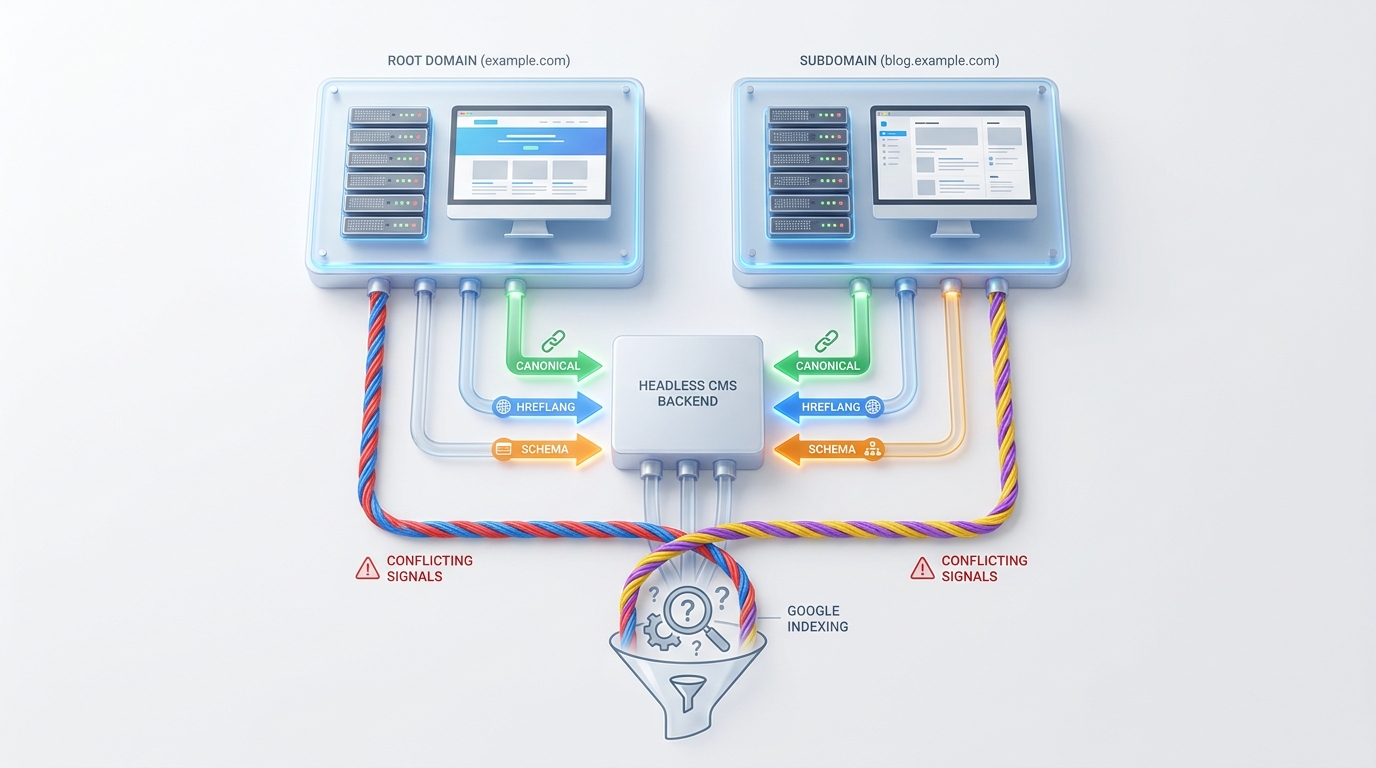
SEO teams often discuss ranking signals as if they are independent levers. Publish better pages. Improve internal links. Earn mentions. Build topical depth. Those things matter. But they lose force when the technical foundation cannot answer a basic question consistently: which URL, on which host, is the definitive version of this page?
Every answer should have been the root domain. Ours was not reliably doing that.
Why this hurts more than a temporary traffic dip
A decline in Google visibility is never just a chart problem. It interrupts a compounding system.
Organic discovery is valuable because it can create repeated exposure without requiring a fresh payment for every visit. A useful page earns a place in search, attracts attention, supports brand recognition, creates paths into the rest of the site, and can continue doing that work long after publication.
That is why authority is an asset. It is not merely an SEO score. It is accumulated proof that the market can find you, understand you, and return to you through a reliable owned surface.
When signals split across a root domain and a subdomain, the loss is bigger than a ranking position. The business weakens the machine that makes visibility compound. Search engines have less clarity. Link equity has less certainty about where it belongs. Content relationships become harder to interpret. Pages that should reinforce one another may be treated as parallel or competing assets.
That is exactly what makes this class of failure so frustrating. The content team can still be doing good work. The editorial calendar can be full. The pages can be genuinely useful. Yet the distribution layer has been compromised beneath them.
Content is not distribution. Publishing more while an indexation conflict remains unresolved is just adding inventory to a warehouse with the wrong address.
What we changed to recover
Recovery required a consolidation effort, not cosmetic SEO work.
First, we implemented automated canonical logic so every page had one absolute canonical URL pointing to the root domain. Not relative canonicals. Not a mix of environment-specific outputs. Not a template-level assumption that a CMS dashboard appeared to be doing the right thing. Every indexable page needed to state the same answer clearly in the rendered HTML.
That absolute canonical rule matters because technical systems drift. Content models change. New templates appear. A preview environment gets exposed. A different publishing workflow generates metadata. If canonical logic is manual or inconsistently controlled, the site eventually produces exceptions. At scale, exceptions become the architecture.
Second, we consolidated sitemap logic. We created a sitemap index file at the primary root domain and used it to reference the individual sitemaps generated by the CMS. We submitted only that root-domain sitemap index in Google Search Console.
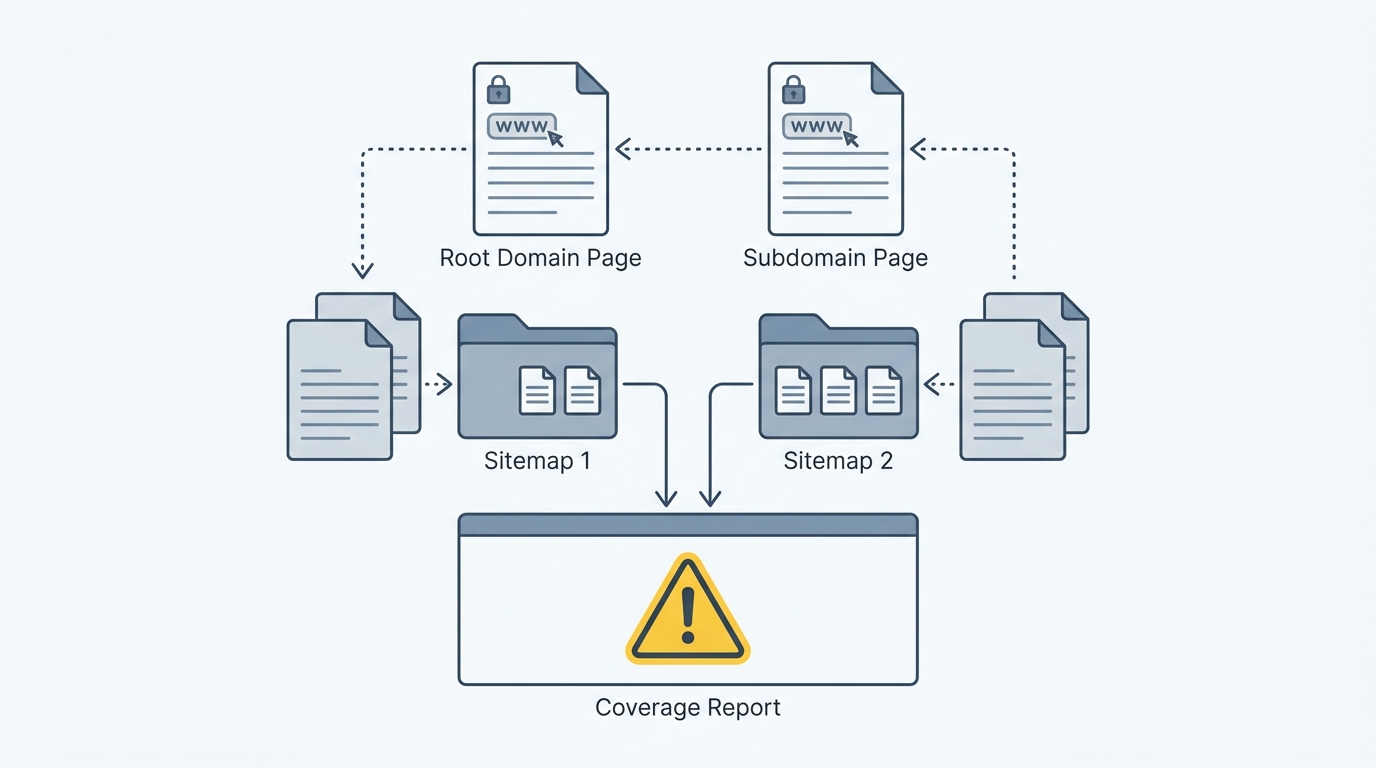
This sounds administrative. It is not. A sitemap is an instruction about what you consider part of the site’s indexable inventory. When sitemap structures point in different directions, they create another layer of ambiguity. The root domain needed to become the obvious, consistent center of gravity.
Third, we implemented redirects at the edge. Old subdomain URLs automatically redirect to their corresponding root-domain URLs before Googlebot touches the origin server for redirected content.
This was critical. A canonical tells a search engine which version you prefer. A redirect removes the choice for a user agent arriving at the old destination. When the business has already decided that the root domain is the only public home for the content, the system should enforce that decision as early and as cleanly as possible.
Fourth, we designated one source of truth for metadata. Multiple CMS instances should not be allowed to independently decide titles, descriptions, canonical URLs, hreflang output, or indexation directives. That is not redundancy. It is governance failure.
Finally, we audited what the crawler could actually see. Not what a CMS interface claimed to generate. Not what a deployment configuration was supposed to do. We checked the raw HTML output for canonicals, hreflang, metadata, and indexation signals.
This is a discipline more teams need. Dashboards are not the website. The rendered response is the website.
Search Console showed the consequence, but the architecture caused it
It is tempting to treat Search Console as the place where SEO issues are discovered and fixed. That is only half right.
Search Console can expose the symptoms: unexpected URLs, indexing patterns, canonical selections, sitemap problems, and visibility changes. It gives the operator an essential view of how Google is interacting with the site.
But Search Console cannot compensate for a business that has not made an architectural decision. It cannot decide which host should own the authority. It cannot impose a metadata governance model. It cannot make competing systems stop generating conflicting signals.
The painful part of this incident was not that the warning signs were impossible to find. It was that our system had not been designed around the principle that every public page needs one durable, authoritative home.

That is the operational standard now. Every site change, CMS change, template change, and publishing change needs to preserve that singular answer.
This matters even more as discovery fragments
Google Search is still central, but it is no longer the only surface through which a company is discovered. People encounter brands through YouTube, ChatGPT, Gemini, AI Overviews, direct recommendations, and branded search journeys that begin somewhere else entirely.
That does not make technical SEO less important. It makes it more foundational.
Generative search systems and AI Overviews increase the value of clean source material. If a business wants its owned pages to be the durable reference point for its expertise, positioning, and reputation, it cannot afford an incoherent web presence. Old or duplicate surfaces can persist. Competing URLs can confuse not only classic search indexing but the wider discovery environment built on crawlable, retrievable web content.
For leaders, the implication is straightforward: do not measure content only by what gets published. Measure whether every published asset strengthens a single owned authority system.
The strongest companies do not build visibility by creating more disconnected pages across more systems. They build a clear center of gravity, then make every channel, page, and technical decision feed it.
What we would do differently now
We would treat indexation governance as a launch requirement, not a cleanup task.
- Define the one public host that owns the brand’s search authority before a headless implementation goes live.
- Make absolute root-domain canonicals automatic for every relevant page type.
- Maintain one root-domain sitemap index and submit that single index through Search Console.
- Redirect obsolete subdomain URLs at the edge, rather than allowing crawlers to reach an origin that should no longer be public.
- Give one system ownership of metadata, canonical rules, hreflang, and indexation directives.
- Audit raw HTML regularly, especially after CMS, template, deployment, or routing changes.
This is not glamorous work. It will not produce a flashy presentation slide. It does not feel as satisfying as launching a new content series or redesigning a homepage.
But systems outperform manual effort. A correct publishing architecture protects every future article, page, and asset. An incorrect one taxes every future investment in content.
TL;DR
We lost roughly a quarter of our Google visibility because our root domain and a headless CMS subdomain were allowed to split ranking and indexing signals. The failure was architectural, not editorial.
We recovered by forcing consolidation: absolute canonicals to the root domain, a root-domain sitemap index, edge-level redirects from old subdomain URLs, one source of truth for metadata, and audits of raw HTML rather than CMS dashboards.
The lasting lesson is bigger than one technical incident. Visibility compounds only when the business gives search systems one clear version of reality. Build one authoritative home for your content, enforce it through systems, and do not let a convenient technical setup fracture the asset you are trying to compound.
Find the channels buyers already trust before competitors own them.
We map your acquisition channels, visibility gaps and distribution constraints, then show where market presence can compound into qualified demand.