You Built the App. Distribution Was the Second Product You Forgot
 Julia
Julia
Across the companies we study, the same expensive mistake keeps repeating: a founder spends months building an app, polishing the interface, tightening onboarding, and preparing for launch-then discovers that launch is not a distribution strategy.
That discovery usually arrives after the product is live. The App Store listing is published. A launch post goes up on LinkedIn. A few friendly users sign up. Then the graph flattens. The founder has built software, but not a reliable way for the right people to find it, trust it, adopt it, return to it, and tell someone else about it.
Our stake in this argument is practical. We work in the part of company-building where attention, discovery, authority, and demand determine whether a useful product becomes a business. We have watched technically capable teams treat distribution as a task for the week before launch, then act surprised when their product enters a market where nobody was waiting for it.
Get practical tips to manage marketing without adding noise.
Short field notes on positioning, distribution and turning expertise into demand. Written for founders and operators, not marketers chasing trends.
That approach is no longer merely incomplete. In an AI-driven software market, it is a category error.
Distribution is the second product, and it has to be built before launch
The old founder sequence was simple: build the thing first, then work out how to get it into people’s hands. It made some sense when software took serious capital, long development cycles, and deep technical scarcity to create. In the capital-and-technology era, deployments could take 12 to 24 months. Companies needed multi-year capital to build, sell, and deploy software. Product scarcity created room to figure out demand later.
That room has disappeared. AI has pushed the cost of building software close to zero-and, more importantly, pushed the cost of copying software down with it. A useful feature can be replicated. A clean interface can be imitated. A workflow can be recreated. Even a product category can be crowded before its first serious company has learned how customers actually buy.
The durable advantage now lives somewhere less glamorous: in how efficiently a company earns attention, turns that attention into adoption, keeps customers engaged, and becomes the default name people remember when the category comes up.
That is distribution. It is not “marketing after product.” It is a product in its own right: one with users, onboarding, retention, feedback loops, channels, constraints, and compounding value.
Key takeaways
- Launch-day marketing is a category error. A launch is an event. Distribution is an asset built over time.
- AI made product execution cheaper, not customer attention cheaper. The easier software becomes to build and copy, the more valuable audience ownership becomes.
- Adoption is part of distribution. Decisions about onboarding, UX, integrations, and user behavior determine whether attention turns into active use.
- Pre-launch runway matters more than launch-day noise. A company should enter the market with discovery already compounding, not with an empty audience and a deadline.
Launch day is not the beginning of distribution
Founders often talk about launch as though it is the moment a product becomes real. It is usually the moment the company finds out whether it did the work that made a product discoverable.
A LinkedIn announcement, an iOS release, and an App Store submission can create a brief spike in awareness. None of them creates a durable route to demand on its own. They do not establish why a buyer should care. They do not create familiarity. They do not explain the problem in language customers already use. They do not build trust before the moment of purchase. They do not solve the adoption gap after someone signs up.
The mistake is treating launch as a distribution mechanism rather than what it actually is: a deadline inside a distribution system.
Before launch, a founder should already know where attention comes from, what message earns it, which users are most likely to adopt, what stops them from adopting, and what makes the product easy to share or integrate into existing behavior. Those are not promotional questions. They are product questions because they determine whether the product has a path into the market.
When those answers are deferred, the build phase quietly hard-codes the wrong assumptions. Onboarding may assume users understand a problem they do not yet recognize. UX may ask for effort before delivering clarity. The product may require a behavior change that the distribution plan never accounted for. The app may be technically impressive but impossible to explain in one useful sentence.

Then the founder calls the problem “marketing.” It is often not marketing. It is a product that was built without a route to adoption.
The real moat is becoming the default brand before competitors arrive
The Distribution Era thesis is blunt: the moat is shifting from the product itself to the audience and the distribution system around it. The winning company is increasingly the one that becomes the default brand in a category before interchangeable competitors can occupy the same space.
This is why authority is not a vanity project. It is an operating asset. When a company is repeatedly associated with a problem, a category, or a useful point of view, it lowers the cost of being chosen. Buyers arrive with context. They understand the company’s framing. They have seen evidence of competence. They are less likely to begin the relationship from total indifference.
That advantage compounds. A useful explanation can create discovery. Discovery can create an audience. An audience can create feedback. Feedback can improve positioning, onboarding, and product decisions. Better product decisions can create adoption. Adoption can create stronger proof, clearer messaging, and more discovery.
That is a system. And systems outperform manual effort because they do not require a founder to restart from zero every time the company needs customers.
The opposite is also true. A founder who depends on a launch post, a single App Store listing, or one burst of paid attention is operating a fragile growth model. Single-channel growth is fragile because the company does not own the underlying demand. It rents access to it.
The fresh-domain result is the pre-launch runway founders should respect
One fresh-domain study makes the case more clearly than most launch stories do: a new site reached parity with a 10-year-old site in four months.
The important lesson is not that every new company will repeat that result. The lesson is that visibility can move faster than founders assume when it is treated as a deliberate pre-launch asset rather than a post-launch emergency.
Four months is not a footnote. It is a planning horizon. It is enough time to build a body of useful category-level thinking, test how the market describes its problem, identify the language that creates recognition, and develop a base of discovery before the product asks the market for anything.
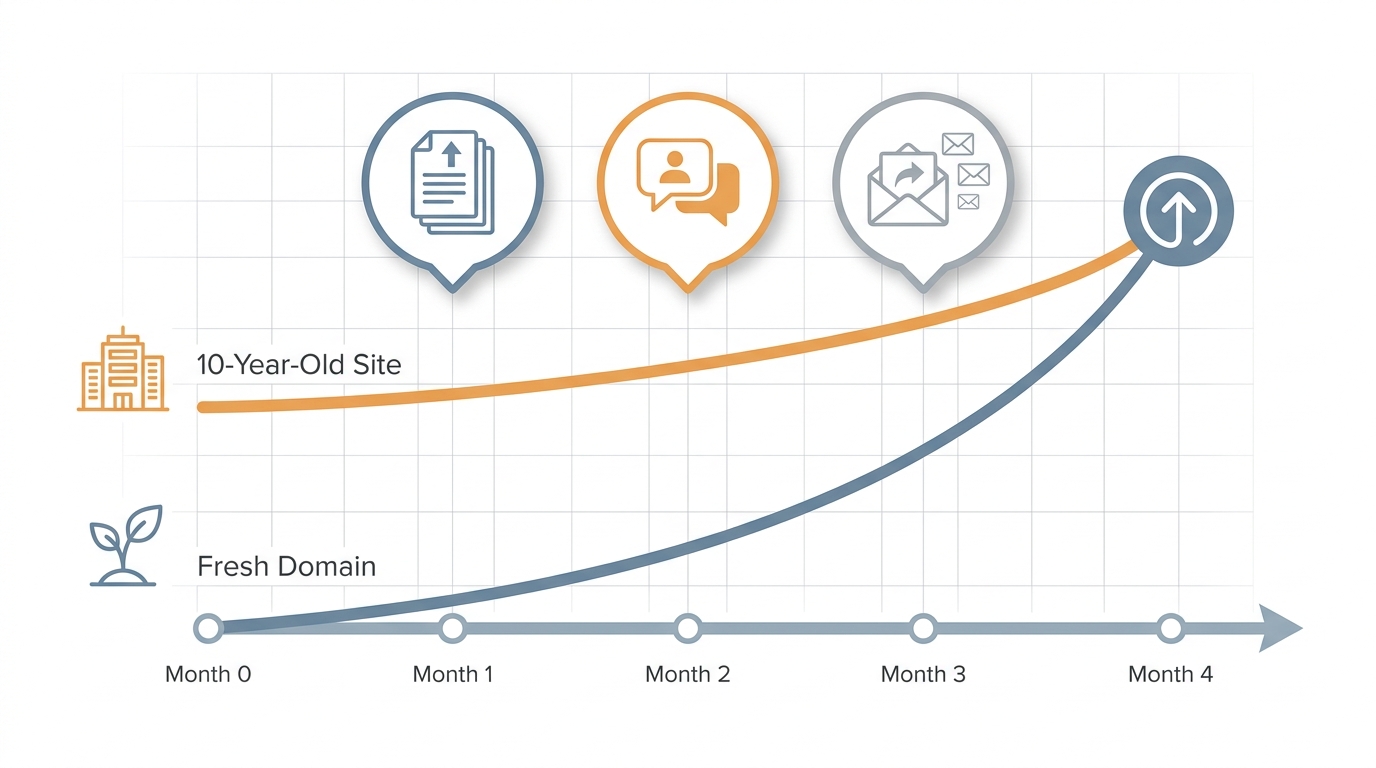
Most founders spend that same window building features in private. They emerge with a product and no visibility, then give themselves a few days to create demand. That is not lean. It is backwards.
Pre-launch runway should be treated with the same seriousness as product runway. If a company expects to ship in four months, it should ask what will compound during those four months besides code. What category association will exist? What audience will exist? What language will have been validated? What adoption objections will have surfaced early enough to influence the product?
If the answer is “we will post when we launch,” the company does not have a go-to-market plan. It has a hope disguised as a calendar date.
Product-led growth worked because distribution was built into the product
The strongest product-led growth stories are often misunderstood. Slack reached a $1 billion valuation before hiring a sales representative. Figma followed a similar playbook. The lazy interpretation is that product quality eliminated the need for distribution.
The opposite is closer to the truth. Product-led growth is distribution designed into the product experience. The product is not merely useful after purchase; it creates a path for people to encounter, adopt, and spread it. Its growth model is inseparable from the way users receive value.
That distinction matters because too many founders build a conventional product, call it PLG, and assume a free tier or an App Store listing will do the rest. It will not. Product-led growth is not the absence of go-to-market. It is go-to-market embedded in the product’s route to adoption.
The same standard applies to AI products. Model quality alone is not the business. People already use AI on their own, often outside formal company systems. This shadow AI economy proves that demand for capability exists. The hard problem is integration and adoption: turning scattered personal behavior into a trusted, repeatable, useful workflow.
That is why the winners will not simply be the companies with access to capable models. They will be the companies that make the new behavior understandable, adoptable, and easy to repeat inside the environments where work already happens.
Adoption friction is a distribution failure, not just a UX problem
There is a habit in software teams of separating product, design, growth, and go-to-market into neat functions. Customers do not experience the company that way. They experience one continuous journey: discovery, understanding, trust, signup, onboarding, first use, repeat use, and recommendation.
Every break in that journey weakens distribution.
A product that is difficult to explain will struggle to be discovered. A product that promises one thing and asks users to do another will struggle to be adopted. A product that creates value only after substantial effort will struggle to retain attention. A product that cannot fit into existing workflows will struggle to become habitual, even if its underlying technology is excellent.
Zapier offers a useful example of clarity as an adoption strategy. CEO Wade Foster’s 2023 “AI Code Red” company-wide challenge did not treat AI as a feature announcement. It treated AI as a company-wide behavior and an operating priority. That is the difference between shipping access to a capability and creating the conditions for people to use it.

Founders should take that lesson seriously. A distribution strategy is not complete when it gets somebody to a landing page. It is complete only when the right user gets to durable value with enough clarity to continue.
Building before validating distribution is how companies build for nobody
The statistic is uncomfortable because it exposes how preventable the problem can be: 42% of startups fail because they build something nobody wants. That failure is often framed as a product-market-fit issue, but it is also a distribution-first failure.
A company that has not built proximity to its market has less chance of understanding what people want, how they describe the problem, what they already use, what triggers a search for a solution, and what makes switching feel worthwhile. It is trying to make strategic product decisions from inside the building.
Distribution-first validation changes that. It forces the company to earn attention before it assumes demand. It creates contact with the words, objections, and behaviors that should shape product choices. It reveals whether an idea is merely possible to build or genuinely compelling to adopt.
This does not mean founders should wait for an enormous audience before building. It means they should stop treating audience development as unrelated to product development. The two should inform each other from the beginning.
What app founders should build alongside the app
Founders who have already built the product do not need a lecture about missed timing. They need a more useful operating model: distribution becomes the second product from this point forward.
- Build category clarity. Define the problem and the company’s point of view in language the market can recognize and repeat.
- Build owned attention. Create an audience the company can reach without depending entirely on the App Store, LinkedIn distribution, or a single rented channel.
- Build discovery systems. Make useful ideas, useful language, and useful proof consistently findable over time.
- Build adoption into product decisions. Design onboarding and user behavior around the reality of how people discover, evaluate, and integrate a new tool.
- Build feedback loops. Let market response improve the product, and let product learning improve the company’s distribution.
None of this is a substitute for a good product. It is the condition that allows a good product to become visible enough to matter.
The central shift is simple: stop asking how to market the app after it is done. Start asking what distribution asset the company is compounding while the app is being built.
TL;DR
AI has made it cheaper to build software and easier for competitors to copy it. That makes product alone a weaker moat. The defensible advantage is increasingly the company’s ability to earn attention, own an audience, create adoption, and become the default brand in its category.
Launch-day marketing is not a strategy. It is a late-stage event inside a much larger system. The app is one product. Distribution is the second product-and founders who build both before launch give themselves a chance to compound visibility instead of chasing it.
Find the channels buyers already trust before competitors own them.
We map your acquisition channels, visibility gaps and distribution constraints, then show where market presence can compound into qualified demand.