Your Dashboard Measures the Channel That’s Dying—and Ignores the One Growing
 Julia
Julia
Across the companies we study, the most dangerous dashboard problem is not bad data. It is a perfectly tidy dashboard answering the wrong question with great confidence. The clearest break came into view in June 2026 on one property: 112,585 AI citations and 3,874 Google clicks in the same month.
Those are not competing versions of the same metric. They are explicitly different units. AI citations measure instances in which the property was surfaced in AI-generated answers. Google clicks measure recorded visits from Google Search. One is a visibility signal. The other is an acquisition signal. Neither can be divided by the other to produce a meaningful conversion rate, and neither proves the commercial value of the other on its own.
But that gap exposes the problem every marketing leader reporting to a CEO or board now has to confront: the dashboard still privileges the click, even as an increasing share of discovery happens before, around, and without one. We are using a measurement model designed for the ten-blue-links era to judge a discovery environment that has changed underneath it.
Get practical tips to manage marketing without adding noise.
Short field notes on positioning, distribution and turning expertise into demand. Written for founders and operators, not marketers chasing trends.
The dashboard is not broken. Its definition of marketing is obsolete.
For years, traffic was a reasonable shorthand for whether content was working. A person searched, saw a result, clicked, landed on a site, and entered an analytics system with a referrer attached. It was never perfect, but it was legible enough to support budget decisions.
That journey is no longer the default. Google AI Overviews, AI Mode, ChatGPT, Perplexity, Claude, Bing Copilot, mobile interfaces, copied answers, and zero-click behavior have inserted new layers between a company’s expertise and the visit its dashboard can recognize. The old model records the final handoff. It misses much of the influence that happened before it.
This matters because a board dashboard does more than report performance. It determines what gets funded, what gets cut, and which teams are told to “focus on what works.” If the dashboard can only see clicks, the business will systematically overvalue work that produces trackable sessions and undervalue work that earns discovery inside the interfaces customers increasingly use to make decisions.
Key takeaways
- Traffic is no longer a complete proxy for content value. AI-mediated discovery can create awareness and consideration without producing a recognizable referral session.
- AI citations and Google clicks must stay separate. Citations are visibility signals; clicks are visits. Blending them creates false precision.
- “Direct” is increasingly an unresolved bucket, not a clean source category. Mobile apps, copied URLs, and generative search journeys can erase the referrer before the session reaches analytics.
- Discovery needs its own measurement layer. Boards should see AI visibility, identifiable AI-assisted visits, unknown/direct arrivals, and on-site business outcomes as distinct parts of one system.
The click is shrinking as the default proof of discovery
The numbers make the direction hard to ignore. In the first four months of 2026, 68% of U.S. Google searches ended without a click. That is not a small tracking anomaly. It is a structural change in how people use search.
When a Google AI Overview appears, click-through rate falls by nearly 60%. Only about 1% click a link within the AI Overview itself. A conventional traffic dashboard interprets this as a simple verdict: the page lost demand, the topic is less valuable, or the content failed.
That interpretation is often lazy. A user may have received enough of an answer to leave without clicking. They may have seen a company named, cited, or framed as an authority and then returned later through another route. They may copy a URL from an AI interface, type a company name into a browser, or come back through a bookmarked page. The company can participate in the decision while receiving none of the session-level credit.
ChatGPT referrals grew 206% in 2025 in clickstream analysis covering 17 months of U.S. data. That is meaningful, but it is still only the visible portion: the sessions where a referral survives and is passed through. Treating referral growth as the full AI channel is the same error as treating recorded clicks as the full value of organic search. It confuses what is observable with what is happening.
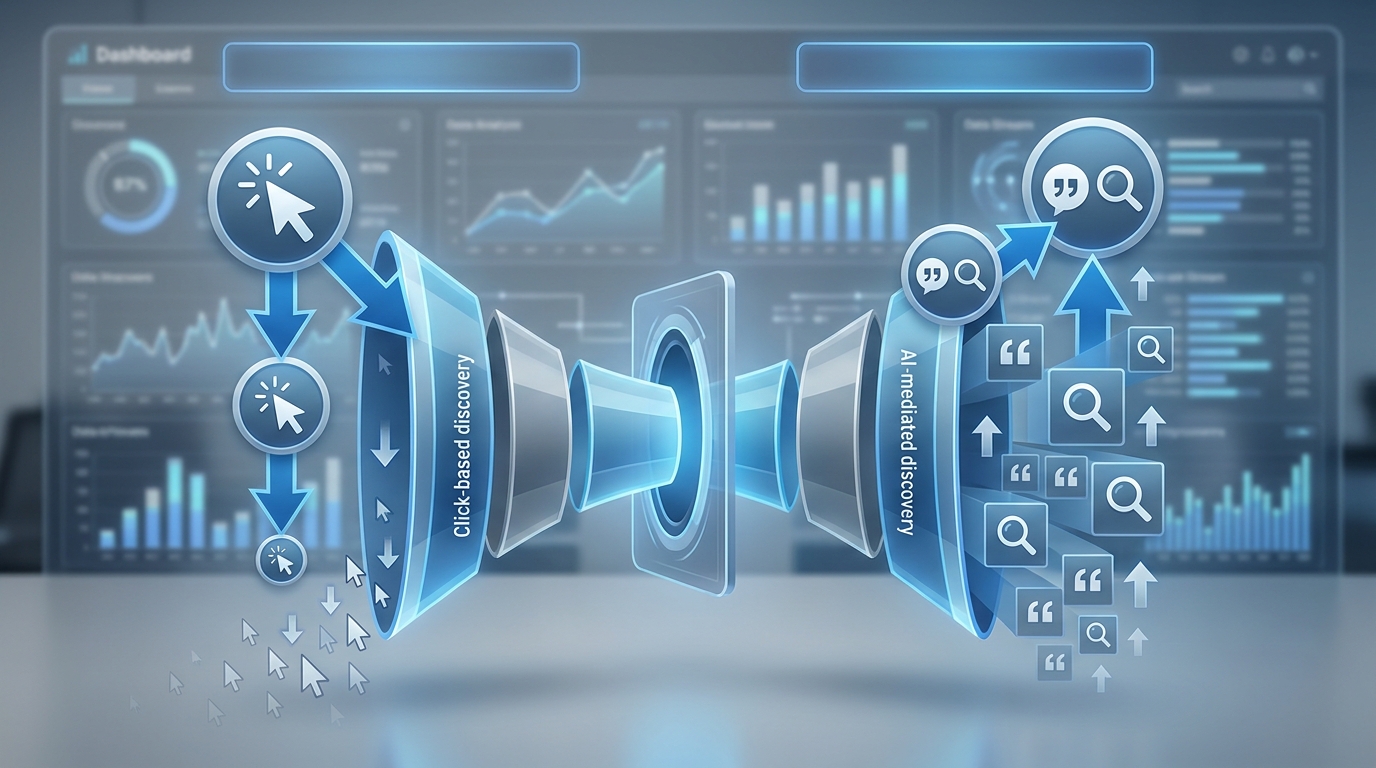
We should be clear about the conclusion. This does not mean traffic no longer matters. It means traffic is now a narrower measure than the content strategy it is being asked to judge.
“Direct” has become a graveyard for attribution
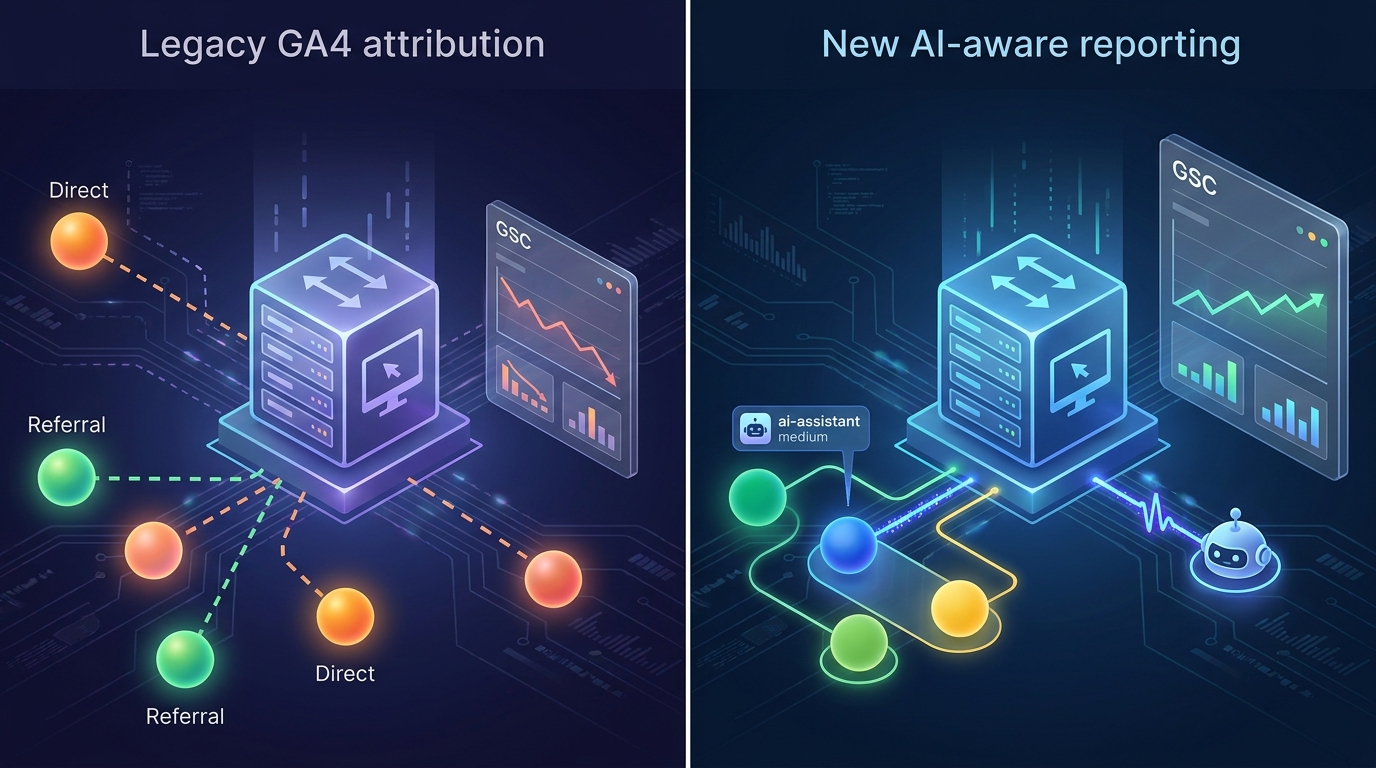
The attribution problem becomes more severe on mobile. People frequently use AI assistants inside mobile apps, where referrer headers can be stripped before the session reaches a website. What began as an AI-influenced journey arrives in analytics as Direct.
Copy-and-paste behavior creates the same outcome. Someone receives an answer, copies a company URL, opens a browser, and visits directly. No conventional source record connects that visit to the AI response that created it. The dashboard records a direct session and tells a neat but incomplete story.
Google AI Overviews create another blind spot. A company can be visible in the answer, influence the user’s understanding, and still receive neither a click nor an attributable session. That influence does not become less real because GA4 has no referrer to assign.
The worst response is to relabel every direct visit as AI traffic. That is not measurement; it is wishful attribution. Direct remains an unknown bucket containing many paths. The disciplined response is to acknowledge the gap, preserve it in reporting, and stop pretending that a low-click journey has no commercial relevance simply because its influence cannot be assigned with the old rules.
The June 2026 gap is a warning, not a vanity metric
Return to the June 2026 example: 112,585 AI citations versus 3,874 Google clicks on one property. The temptation is to frame that as an extraordinary ratio or to declare that AI citations are “worth” a particular number of clicks. That would be a category error.
A citation is not a visitor. It does not tell us whether the cited answer was read closely, trusted, remembered, or converted into a commercial action. A Google click is not the complete value of a page either. It tells us that a visit occurred, not whether the visitor discovered the brand for the first time, whether they had encountered it earlier in an AI answer, or whether the page built authority that will shape future discovery.
The value of the June figures is not that they create a new winner-takes-all KPI. Their value is diagnostic. They show that the company’s visible presence in AI answers was vastly larger than the portion of Google traffic the conventional dashboard used as its primary proof of discovery. A board that sees only 3,874 clicks is not seeing the whole commercial environment.
This is the central operating lesson: visibility compounds before attribution catches up. Companies that are repeatedly cited become easier to encounter, easier to recognize, and more likely to be considered. The analytics system may show only fragments of that process. The market does not wait for a clean referrer before it forms an opinion.
What we would instrument instead
The answer is not a new vanity dashboard and not an attempt to force every AI interaction into a fake channel report. It is a measurement architecture that separates discovery from acquisition and treats uncertainty honestly.
- AI citation visibility. Record when and where the company’s property is cited in AI-generated responses. This is a discoverability measure, not traffic and not revenue. Its purpose is to show whether the company is present in the answers shaping a category.
- Identifiable AI-assisted visits. Segment sessions that do retain a recognizable AI-assistant source. These are useful acquisition signals, but they should be reported as the attributable portion of AI-mediated discovery, not as the whole channel.
- Direct and unknown arrival paths. Keep direct traffic visible as unresolved rather than silently treating it as proof that a user arrived without influence. It is important to preserve the uncertainty instead of assigning credit that the data cannot support.
- On-site business outcomes. Measure the commercial actions that occur on the company’s own property after arrival. The relevant action will differ by business, but it should remain separate from the visibility layer and the referral layer.
- Content-level discovery patterns. Connect cited pages and topics to identifiable visits and on-site outcomes without pretending every citation led directly to a session. The goal is not a mythical single metric. The goal is a more accurate decision system.
This structure prevents a common reporting mistake: using the same metric to assess every stage of growth. Citations answer whether the business is being surfaced. Referrals answer whether a source passed a visitor through. On-site outcomes answer whether an arrival did something that matters. These are related, but they are not interchangeable.
There is also a reporting break that leaders need to handle carefully. From May 13, 2026, new ai-assistant medium values allow traffic from assistants such as ChatGPT, Perplexity, Claude, and Bing Copilot to be segmented separately from Referral or Direct. That is useful for future reporting. It is not retroactive. Sessions before that point remain classified under their earlier labels, which means default month-on-month comparisons can create a false story in which AI traffic suddenly appeared from nowhere.
It did not appear from nowhere. The dashboard simply gained a better label for a portion of traffic it had previously misclassified.

Boards should stop asking content to prove itself with one number
A CEO or board does not need a lecture on referrer headers. They need a decision-grade view of how the business earns discovery, turns discovery into visits where possible, and converts identifiable demand on its own property.
That changes the conversation. Instead of asking why a page lost clicks after an AI Overview appeared, leadership can see whether the company is still being surfaced in the category, whether identifiable AI-assisted traffic is growing, what share of arrivals remains unknown, and whether the business is generating outcomes once people reach an owned destination.
This is not softer measurement. It is stricter measurement. It refuses to claim that a citation equals a sale. It also refuses to claim that an uncredited journey had no value. Both forms of overconfidence lead to bad allocation decisions.
The companies that win this shift will not be the ones obsessing over a new source label in a weekly traffic report. They will be the ones building a durable discovery system: content and product information structured well enough to be surfaced, authority strong enough to be cited, and owned destinations capable of turning attention into a relationship and an outcome.
TL;DR
Your traffic dashboard is still useful, but it is no longer a complete map of how customers discover a company. AI Overviews, AI assistants, mobile apps, copied links, and zero-click behavior have weakened the connection between influence and the referral data GA4 receives.
In June 2026, one property generated 112,585 AI citations and 3,874 Google clicks. Those are different units and should remain different units. The lesson is not to replace traffic with citations. The lesson is to stop using traffic as the sole verdict on whether content, authority, and discovery are working.
Discovery is now a business function, not a line item in an acquisition report. Measure visibility, identifiable visits, unknown paths, and on-site outcomes separately. The businesses that do will make better decisions while everyone else keeps optimizing a dashboard built for the channel that is fading.
Find the channels buyers already trust before competitors own them.
We map your acquisition channels, visibility gaps and distribution constraints, then show where market presence can compound into qualified demand.